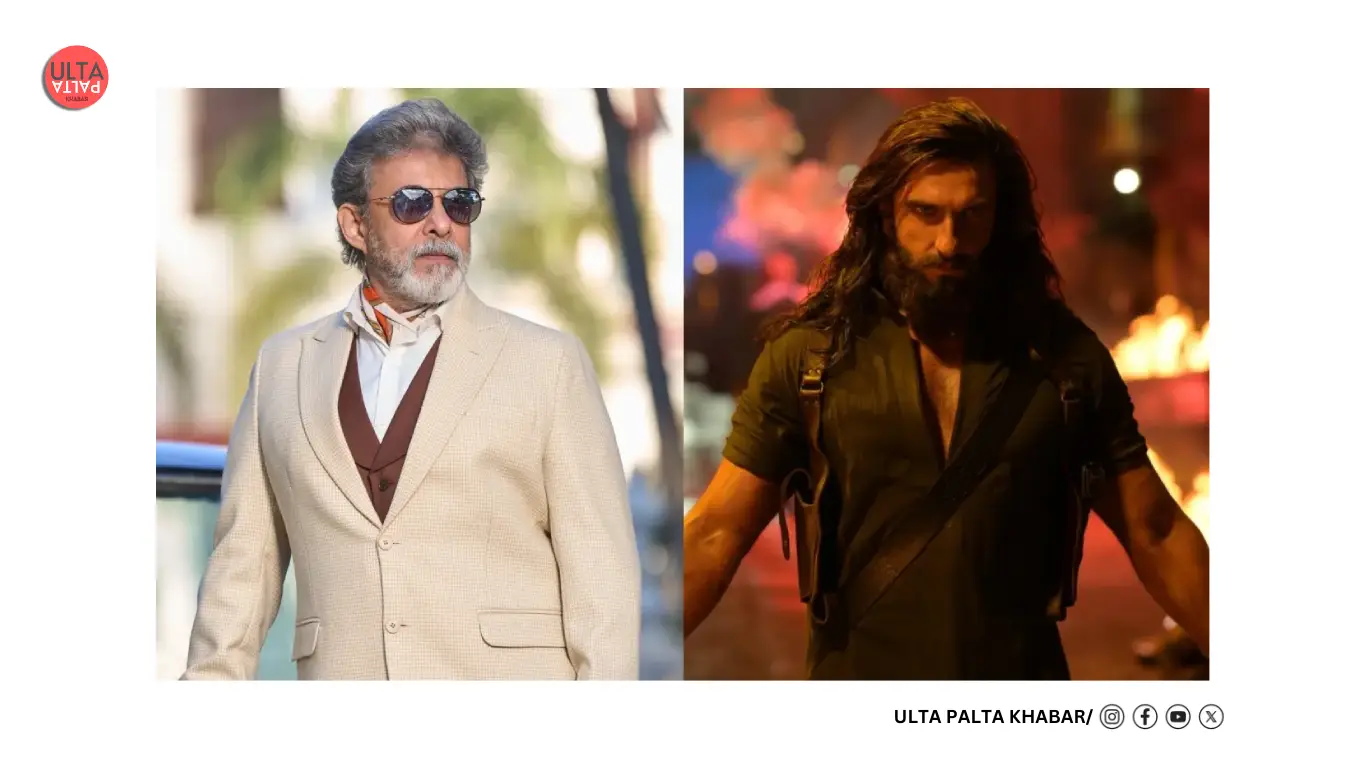

As Ranveer Singh’s mega-hit storms the box office, censorship controversy sparks fresh debate over OTT vs theatrical cuts
The box office is roaring, the numbers are historic, and the audience is hooked—but amid all the celebration around Dhurandhar: The Revenge, a controversy is brewing that could reignite one of Bollywood’s oldest debates: censorship vs logic.
Veteran actor Deepak Tijori has publicly questioned the functioning of the Central Board of Film Certification (CBFC), calling out what he describes as “half-muted” abusive language in the film—despite it carrying an Adults Only (18+) certification.
And his blunt take has struck a chord across the industry and audience alike.
Note: For optimal viewing on mobile devices, rotate the screen.
The ₹1000 crore storm with a censorship twist
Directed by Aditya Dhar, Dhurandhar: The Revenge has turned into a full-blown phenomenon. Headlined by Ranveer Singh, the high-octane spy thriller has already crossed ₹650 crore domestically and smashed past the ₹1000 crore mark worldwide—firmly placing it among the biggest Indian blockbusters of recent times.
The film, which also stars R. Madhavan, Arjun Rampal, Sanjay Dutt, Rakesh Bedi and Sara Arjun, traces the gritty transformation of Ranveer’s character from Jaskirat Singh Rangi to Hamza Ali Mazari—a feared kingpin operating out of Lyari while secretly dismantling terror networks.
It’s dark, violent, politically charged—and unapologetically raw.
Which is exactly where the problem begins.
Note: For optimal viewing on mobile devices, rotate the screen.
Deepak Tijori’s blunt call-out
Taking to social media, Deepak Tijori didn’t mince words. In a sharply worded post, he questioned the logic behind muting only parts of abusive words while leaving the rest audible.
His central argument? If a film is already certified for adults, why censor it halfway?
“Who exactly are we protecting here? And from what… half a word?” he asked, pointing out the apparent inconsistency in the certification process.
But he didn’t stop there.
Tijori also highlighted what many viewers have quietly observed for years—the stark difference between theatrical and OTT versions of the same film.
“The same film releases on OTT completely unmuted… untouched… exactly as it was meant to be. And that’s where kids end up watching it,” he noted.
It’s a contradiction that has long existed but rarely been addressed this directly.
Audience backs the outrage
Social media quickly turned into a chorus of agreement.
Fans flooded comment sections, echoing Tijori’s confusion and frustration. Many questioned why censorship exists at all for A-rated films, while others took a dig at the CBFC’s inconsistent guidelines.
The underlying sentiment is clear: viewers are no longer passive consumers—they’re questioning the system.
And in the age of social media, such conversations don’t stay contained for long.
The CBFC dilemma: Control vs credibility
The controversy once again puts the Central Board of Film Certification in a tricky position.
Historically, the CBFC has operated under a dual mandate—certify films and ensure they adhere to certain moral and cultural standards. However, with evolving audience sensibilities and the rise of global content, that role is increasingly being challenged.
The “half-muting” practice is particularly baffling because it sits in a grey zone—neither fully censoring nor fully allowing content.
For filmmakers, it disrupts narrative flow. For audiences, it feels unnecessary and inconsistent.
And for critics, it raises a bigger question: is censorship keeping up with the times?
OTT vs theatres: The growing divide
Tijori’s comments also shine a spotlight on a much larger industry shift—the widening gap between theatrical censorship and OTT freedom.
Streaming platforms operate under different regulations, often allowing filmmakers to present their work without cuts. This has created a situation where the same film exists in two versions—one sanitized for theatres and another unfiltered for digital audiences.
For a film like Dhurandhar: The Revenge, which thrives on realism and intensity, such differences can significantly impact viewer experience.
More importantly, it exposes a loophole: while theatres enforce age restrictions, OTT platforms rely largely on parental control—which is far easier to bypass.
Ironically, the “uncut” version often becomes more accessible than the censored one.
Will this affect Dhurandhar’s run?
From a business standpoint, the controversy is unlikely to slow down the film’s momentum.
If anything, it adds to the buzz.
Controversies—especially those tied to censorship—have historically fueled curiosity, drawing more audiences to theatres. With Ranveer Singh delivering one of his most intense performances and Aditya Dhar crafting a gripping narrative, the film’s core appeal remains intact.
However, the debate could influence its upcoming OTT release.
Viewers may now actively compare versions, potentially amplifying discussions around creative integrity and censorship.
The bigger industry impact
This isn’t just about one film or one actor’s opinion—it’s about an industry at a crossroads.
As Indian cinema becomes more global, the demand for authenticity is rising. Audiences exposed to international content are less tolerant of arbitrary cuts and inconsistencies.
For filmmakers, this could mean pushing back harder against censorship norms.
For the CBFC, it may require a re-evaluation of guidelines—especially for A-rated films.
And for actors like Deepak Tijori, it signals a growing willingness within the industry to speak up.
What happens next?
While the CBFC has yet to respond to Tijori’s remarks, the conversation is unlikely to die down anytime soon.
If anything, it could spark a broader review of certification practices—particularly the logic behind partial censorship.
There’s also the possibility of industry bodies stepping in, advocating for clearer, more consistent guidelines.
Because right now, the system appears caught between two worlds—trying to maintain control while adapting to change.
And that balancing act is becoming increasingly difficult.
The final word
Dhurandhar: The Revenge may be rewriting box office history, but it’s also forcing Bollywood to confront an uncomfortable truth.
Censorship, as it stands, may no longer make sense to the very audience it aims to protect.
And when viewers start questioning logic, the conversation shifts from entertainment to accountability.
In the end, the biggest takeaway isn’t just about muted words—it’s about whether the industry is ready to listen when the noise gets too loud to ignore.
Note: For optimal viewing on mobile devices, rotate the screen.
You May Like:
- ultapaltakhabar.com/gautham-menon-loses-inr-4-25-crore-legal-battle-madras-high-court-verdict-sends-shockwaves-across-tamil-film-industry/
- ultapaltakhabar.com/radikaa-sarathkumars-profit-sharing-power-move-shakes-tamil-cinema-as-thaai-kizhavi-crosses-inr-75-crore-ahead-of-ott-release/
- ultapaltakhabar.com/akshay-kumars-bhooth-bangla-vs-dhurandhar-2-storm-why-this-horror-comedy-gamble-could-change-bollywoods-box-office-game/
- ultapaltakhabar.com/oscars-2026-winners-one-battle-after-another-dominates-as-michael-b-jordan-paul-thomas-anderson-shine-at-98th-academy-awards/



 By
By