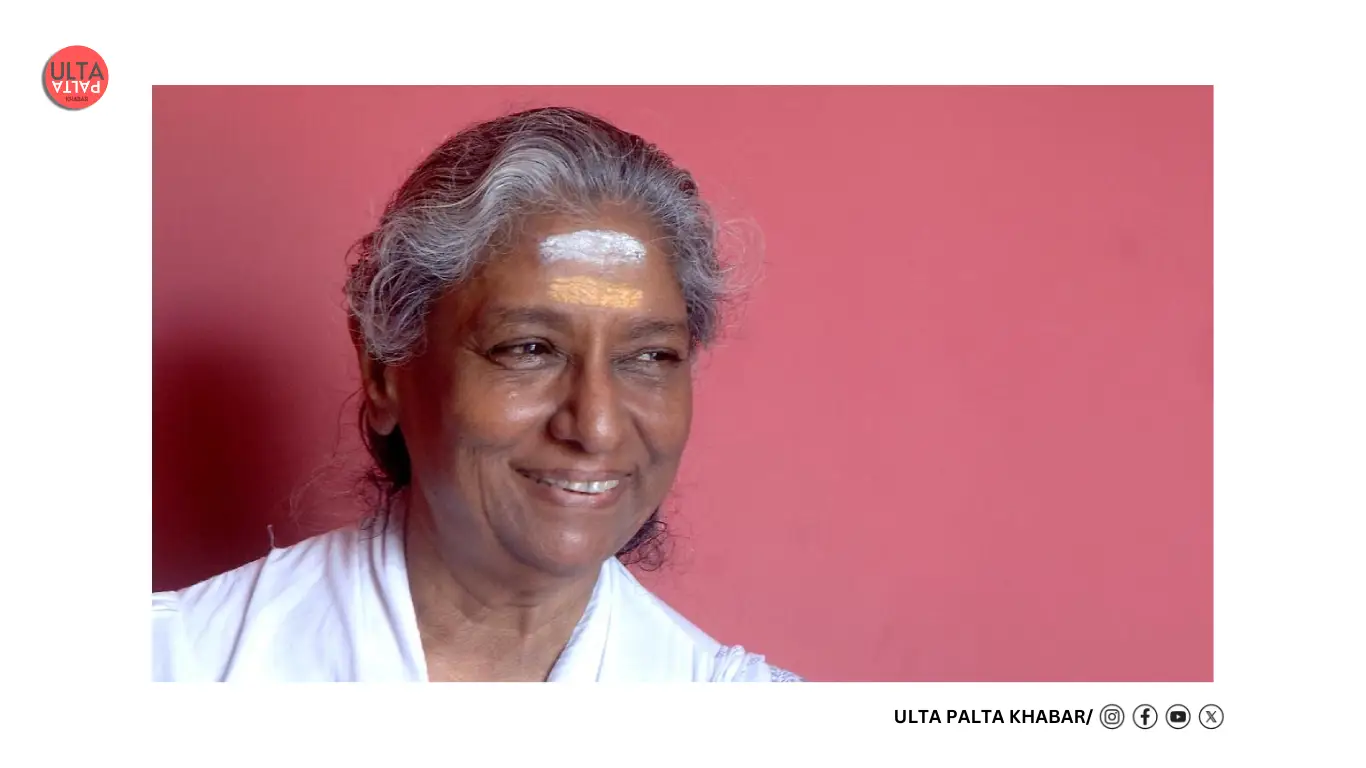

From learning a single Tyagaraja kriti under a nagaswaram maestro to immortalising classics like Singaravelane Deva, S. Janaki proved that talent, emotion and devotion could surpass years of formal training.
For more than six decades, S. Janaki has remained one of Indian cinema’s most celebrated playback singers, enchanting millions with a voice capable of expressing every imaginable emotion. Whether it was romance, sorrow, devotion, joy or heartbreak, Janaki’s singing transcended language, generation and geography.
Yet one of the most astonishing facts about the legendary singer continues to surprise music lovers even today—despite becoming one of India’s finest interpreters of Carnatic-based film music, S. Janaki underwent less than a year of formal Carnatic music training.
In an era where classical singers dedicate decades to mastering ragas, Janaki’s extraordinary achievement stands as one of Indian music’s greatest miracles.
Note: For optimal viewing on mobile devices, rotate the screen.
The Legend Who Defied Every Rule
Playback singing in South India has always shared a deep relationship with Carnatic music. Many legendary singers built their careers after years of rigorous classical education.
S. Janaki followed an entirely different path.
Her formal training lasted barely ten months, yet she went on to sing hundreds of compositions rooted in complex Carnatic ragas with astonishing perfection.
Music historian and author Vamanan, whose work Thirai Isai Alaigal chronicles Tamil film music, believes Janaki possessed something that cannot be taught inside a classroom.
“Whenever she had to sing compositions rooted in the Carnatic tradition, she did so with remarkable mastery. She had an extraordinary grasp of a wide range of musical genres.”
That extraordinary versatility eventually became Janaki’s greatest strength.
Whether composers demanded classical purity, folk simplicity, western orchestration or emotional ballads, she effortlessly adapted her voice to every musical universe.
Note: For optimal viewing on mobile devices, rotate the screen.
The Teacher Who Changed Everything
Behind every musical giant stands a teacher.
For Janaki, that teacher was the respected nagaswaram artist Paitisamy.
He initially taught Janaki’s elder sister, but after hearing the young singer’s natural ability, he immediately recognised her remarkable potential.
According to Janaki herself, Paitisamy wasted no time introducing her to Saint Tyagaraja’s celebrated kriti Nagumomu.
The composition became one of the earliest foundations of her classical understanding.
Sadly, destiny had other plans.
Within ten months, Paitisamy passed away unexpectedly.
The tragedy abruptly ended Janaki’s formal musical education.
For many aspiring singers, that would have meant the end of a dream.
For Janaki, it became only the beginning.
When Natural Talent Became Her Greatest Guru
Unable to continue formal lessons, Janaki relied on what would eventually become her defining strength—an extraordinary listening ability.
Throughout her career, composers frequently praised her uncanny capacity to absorb complex melodies almost instantly.
Instead of depending solely on technical grammar, Janaki internalised emotion, pronunciation, expression and musical structure through observation and relentless practice.
That instinctive approach helped her develop one of Indian playback history’s most flexible voices.
Unlike singers limited to a particular style, Janaki could effortlessly transition between devotional songs, romantic melodies, folk numbers, lullabies, philosophical compositions and highly classical film songs.
This rare adaptability helped her dominate multiple film industries simultaneously.
The Song That Became Immortal
Perhaps no composition better demonstrates Janaki’s classical brilliance than Singaravelane Deva from Konjum Salangai.
Even today, the song is regarded as one of Tamil cinema’s greatest musical achievements.
The composition required extraordinary precision because it featured the legendary nagaswaram maestro Karukurichi Arunachalam.
Matching such an accomplished instrumental virtuoso was no ordinary task.
Yet Janaki’s performance continues to astonish listeners decades later.
The song remains a benchmark for playback singing rooted in Carnatic tradition.
Years later, Janaki herself acknowledged that perhaps her late guru Paitisamy’s blessings guided her through that unforgettable recording session.
For countless music lovers, Singaravelane Deva is more than a song.
It is musical history.
Devotion Beyond Cinema
Although cinema made S. Janaki a household name, her relationship with Carnatic music extended far beyond film studios.
She eventually recorded an entire devotional collection titled Thyagaraja Kritis for Sangeetha Cassettes.
The album showcased her deep respect for classical tradition.
It featured celebrated compositions including:
• Nagumomu
• Rarama Intidaka
• Balakanakamaya
• Entuko Dayaradura
Each kriti was rendered with sincerity rather than exhibition.
Listeners particularly admired the brief Todi alapana that preceded one of the compositions, revealing Janaki’s refined understanding of raga aesthetics despite her limited formal education.
The album remains cherished among devotees and classical music enthusiasts alike.
The Melody That Lived in Her Heart
Interestingly, one of Janaki’s own favourite songs wasn’t among her biggest commercial hits.
She often expressed special affection for Thennankeetru Oonjalile from Paathai Theriyudhu Paar.
Written by celebrated Tamil writer Jayakanthan and directed by Nimai Ghosh, the song was sung alongside playback legend P. B. Srinivas.
Its understated beauty perfectly reflected Janaki’s musical philosophy.
The melody wasn’t technically overwhelming.
Instead, it relied on emotional honesty.
Janaki infused every note with warmth, grace and quiet sophistication.
The result remains timeless.
Why S. Janaki’s Legacy Still Inspires Young Singers
Today’s generation often associates playback singing with technology, pitch correction and digital perfection.
S. Janaki belongs to an era where expression mattered more than perfection.
Her recordings remind aspiring singers that technical knowledge alone cannot create unforgettable music.
Emotion, sincerity and storytelling remain equally important.
Music directors across generations repeatedly trusted Janaki because she never merely sang lyrics.
She lived every word.
Whether portraying a young bride, grieving mother, playful lover or devoted believer, Janaki transformed each song into a complete emotional performance.
That gift cannot be manufactured.
It must come from within.
A Career That Changed Indian Playback Singing Forever
Over the decades, S. Janaki recorded thousands of songs across Tamil, Telugu, Malayalam, Kannada, Hindi and several other Indian languages.
She collaborated with legendary composers including M. S. Viswanathan, Ilaiyaraaja, K. V. Mahadevan, Laxmikant-Pyarelal, Rajan-Nagendra, Hamsalekha and numerous others.
Her career produced countless National Awards, State Awards and lifetime achievements.
Yet perhaps her greatest accomplishment lies elsewhere.
She proved that extraordinary dedication can overcome limited opportunity.
Despite receiving only a few months of classical education, she became one of Indian cinema’s most respected voices for Carnatic-based compositions.
That journey continues to inspire singers who believe their circumstances define their future.
The Everlasting Voice of Indian Cinema
Long after recording her final playback songs, S. Janaki’s music continues to echo through concerts, streaming platforms, radio stations and social media reels.
Young musicians continue studying her breath control.
Classical students analyse her gamakas.
Playback singers admire her emotional intelligence.
And audiences simply continue listening.
In an industry driven by changing trends, Janaki achieved something exceedingly rare—timelessness.
Her story reminds us that legends are not measured by the number of years spent in classrooms but by the emotions they leave behind in millions of hearts.
For Indian cinema, S. Janaki was never just another playback singer.
She became a musical institution.
And every time Singaravelane Deva, Thennankeetru Oonjalile or Nagumomu begins to play, listeners are reminded that true greatness often comes not from perfect training—but from extraordinary passion, relentless dedication and a voice blessed by destiny itself.
Note: For optimal viewing on mobile devices, rotate the screen.
You May Like:
- ultapaltakhabar.com/dharman-rajinikanth-becomes-the-deadly-doctor-as-kamal-haasans-dream-project-finally-takes-shape-after-years-of-delays/
- ultapaltakhabar.com/bts-leader-rm-creates-history-kim-namjoon-becomes-first-ever-global-ambassador-of-national-museum-of-korea-army-celebrates-another-iconic-milestone/
- https://ultapaltakhabar.com/south-korean-box-office-colony-dominates-again-as-spielbergs-disclosure-day-opens-strong-korean-cinema-faces-new-challenge/
- ultapaltakhabar.com/ranveer-singh-gets-massive-relief-as-fwice-revokes-boycott-poonam-dhillon-reveals-actors-father-personally-thanked-her/

 By
By