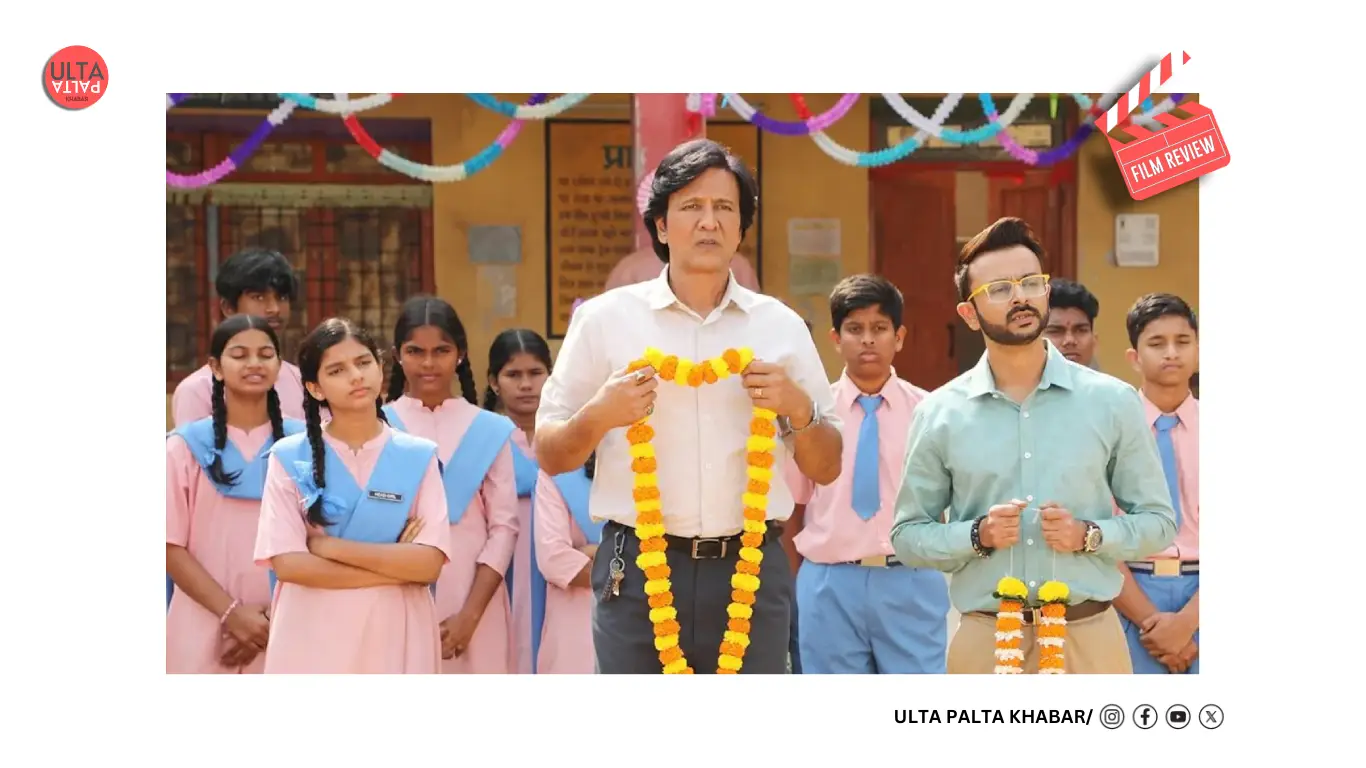

Kay Kay Menon, Archana Puran Singh, Naveen Kasturia and Abhimanyu Singh headline Prime Video’s Adarsh Baal Vidyalaya, but can its government school satire compete with Panchayat and Maamla Legal Hai? Here’s why the internet is divided over the seven-episode comedy-drama.
When Prime Video announced Adarsh Baal Vidyalaya, expectations immediately shot up. The series arrived with a cast led by Kay Kay Menon, Archana Puran Singh, Naveen Kasturia, Abhimanyu Singh, and Deven Bhojani, while creators Biswapati Sarkar and Sameer Saxena carried the reputation of delivering relatable, slice-of-life storytelling.
On paper, the ingredients looked perfect.
A dysfunctional government school.
An ambitious yet flawed principal.
Note: For optimal viewing on mobile devices, rotate the screen.
Teachers with conflicting personalities.
Political interference.
The crumbling education system.
And enough comedy to keep viewers entertained.
But after its release on Prime Video, Adarsh Baal Vidyalaya has sparked an entirely different conversation. Instead of celebrating another heartfelt workplace comedy, viewers and critics are debating whether the series became another victim of the “Panchayat formula.”
Note: For optimal viewing on mobile devices, rotate the screen.
Another victim of the Panchayat effect?
Ever since Panchayat became one of India’s biggest streaming successes, nearly every OTT platform has attempted to recreate the same emotional ecosystem.
Simple people.
Small-town charm.
Relatable problems.
Humour mixed with social commentary.
That formula worked brilliantly because Panchayat never forced its emotions. Every character felt authentic.
Adarsh Baal Vidyalaya clearly tries to enter the same lane.
Only this time, the setting shifts from a village panchayat office to a neglected government school.
The result is familiar—but perhaps too familiar.
Many viewers have pointed out that the show’s DNA resembles Maamla Legal Hai, another legal comedy produced by Posham Pa Pictures. The only noticeable difference is the change of location.
Instead of lawyers struggling inside a courtroom, teachers now struggle inside classrooms.
Unfortunately, changing the background isn’t enough if the storytelling doesn’t evolve.
Kay Kay Menon plays a lovable but confused principal
One of the biggest attractions of the series is undoubtedly Kay Kay Menon.
Known for powerhouse performances in Special Ops, The Railway Men, Shaurya, and numerous critically acclaimed films, Menon rarely disappoints.
Here he plays Gyaneshwar Tripathi, a government school principal whose biggest dream is winning a government-sponsored educational training programme in Cambridge.
Interestingly, Tripathi isn’t driven entirely by noble intentions.
His ambitions are partly selfish.
Yet he remains emotional enough to care for his school.
This contradiction could have created one of the year’s most layered OTT characters.
Instead, many viewers feel the writing never fully explores his personality.
Rather than becoming memorable, the character repeatedly falls back on quirky jokes and exaggerated situations.
The supporting cast deserved stronger writing
Another major talking point is the impressive supporting cast.
Archana Puran Singh continues her acting comeback after recently speaking publicly about not receiving enough meaningful film roles despite decades in the industry.
Fans were excited to watch her in a substantial OTT project.
Similarly, Naveen Kasturia, fresh from several acclaimed streaming projects, brings his trademark sincerity.
Abhimanyu Singh delivers authority whenever he appears on screen.
Deven Bhojani also adds comic energy.
Yet despite everyone’s efforts, audiences feel the script never gives them enough room to truly shine.
The performances remain competent.
The writing doesn’t.
Social issues are raised—but rarely explored
Perhaps the biggest criticism surrounding Adarsh Baal Vidyalaya is its treatment of serious issues.
The show touches upon:
- Poor government school infrastructure
- Mid-day meal problems
- Political interference
- Educational inequality
- Teacher shortages
- Historical manipulation
- Student welfare
Each topic has enormous dramatic potential.
But instead of diving deeper, the narrative often uses them merely as setups for jokes.
For example, one episode involving changes to the school’s kheer distribution under the mid-day meal scheme hints at genuine problems faced by government schools.
However, the issue quickly becomes another comedic sequence instead of meaningful commentary.
Likewise, political attempts to influence school education are introduced but resolved with exaggerated humour rather than thoughtful storytelling.
The result is satire that entertains briefly without leaving a lasting impact.
Viewers question the portrayal of students
Another aspect drawing mixed reactions is the portrayal of schoolchildren.
Many audiences feel the students rarely behave like actual teenagers.
Instead, they often speak with surprising political awareness, engage in elaborate negotiations with teachers, stage protests and deliver philosophical speeches that feel written for adults rather than adolescents.
Some characters also lean heavily into stereotypes.
While exaggeration is common in satire, critics argue these portrayals weaken the show’s emotional authenticity.
Why comparisons with Panchayat may hurt the show
The comparisons were inevitable.
Panchayat succeeded because every joke emerged naturally from believable situations.
Characters evolved gradually.
Relationships felt earned.
By contrast, Adarsh Baal Vidyalaya often appears eager to deliver punchlines before establishing emotional connections.
The comedy arrives.
The emotions arrive.
But they rarely blend seamlessly.
Instead of creating memorable moments, several scenes feel designed solely to generate viral clips.
That approach may work temporarily on social media.
It rarely builds timeless storytelling.
Can the series still find an audience?
Despite mixed reviews, dismissing Adarsh Baal Vidyalaya entirely would be premature.
Streaming audiences often discover shows gradually.
Many series initially criticised have later found loyal fanbases through word-of-mouth.
The cast alone remains a significant attraction.
Kay Kay Menon’s loyal followers are likely to continue recommending the series.
Archana Puran Singh’s return to substantial acting roles also adds curiosity.
Family audiences looking for light-hearted weekend viewing may still enjoy the seven-episode format.
Whether the show becomes another long-running franchise depends largely on audience engagement over the coming weeks.
What happens next?
Prime Video has invested heavily in workplace comedies over recent years.
If Adarsh Baal Vidyalaya manages healthy streaming numbers despite critical reservations, a second season remains possible.
However, future seasons would likely need stronger writing, deeper character development and sharper social commentary to compete in India’s increasingly crowded OTT landscape.
The audience today expects more than quirky characters and feel-good music.
They expect authenticity.
That expectation has been raised by shows like Panchayat, Gullak, Maamla Legal Hai and several other successful streaming originals.
For Adarsh Baal Vidyalaya, the biggest challenge isn’t attracting viewers.
It’s convincing them that the story has something genuinely new to say.
Final Verdict
Adarsh Baal Vidyalaya isn’t a bad show—it simply struggles under the weight of its own ambitions. With a powerhouse cast led by Kay Kay Menon and a timely backdrop of India’s government education system, the series had all the ingredients to become Prime Video’s next breakout hit. Instead, it settles for broad comedy and surface-level satire, rarely digging deep enough into the issues it raises. While its light-hearted tone and quirky characters may appeal to casual viewers, those expecting the emotional depth of Panchayat or the sharp wit of Maamla Legal Hai may come away disappointed. Whether it earns a second season will ultimately depend on audience response, but one thing is certain: the classroom is open, yet the report card remains mixed.
Note: For optimal viewing on mobile devices, rotate the screen.
You May Like:
- ultapaltakhabar.com/dharman-rajinikanth-becomes-the-deadly-doctor-as-kamal-haasans-dream-project-finally-takes-shape-after-years-of-delays/
- ultapaltakhabar.com/bts-leader-rm-creates-history-kim-namjoon-becomes-first-ever-global-ambassador-of-national-museum-of-korea-army-celebrates-another-iconic-milestone/
- https://ultapaltakhabar.com/south-korean-box-office-colony-dominates-again-as-spielbergs-disclosure-day-opens-strong-korean-cinema-faces-new-challenge/
- ultapaltakhabar.com/ranveer-singh-gets-massive-relief-as-fwice-revokes-boycott-poonam-dhillon-reveals-actors-father-personally-thanked-her/





 By
By