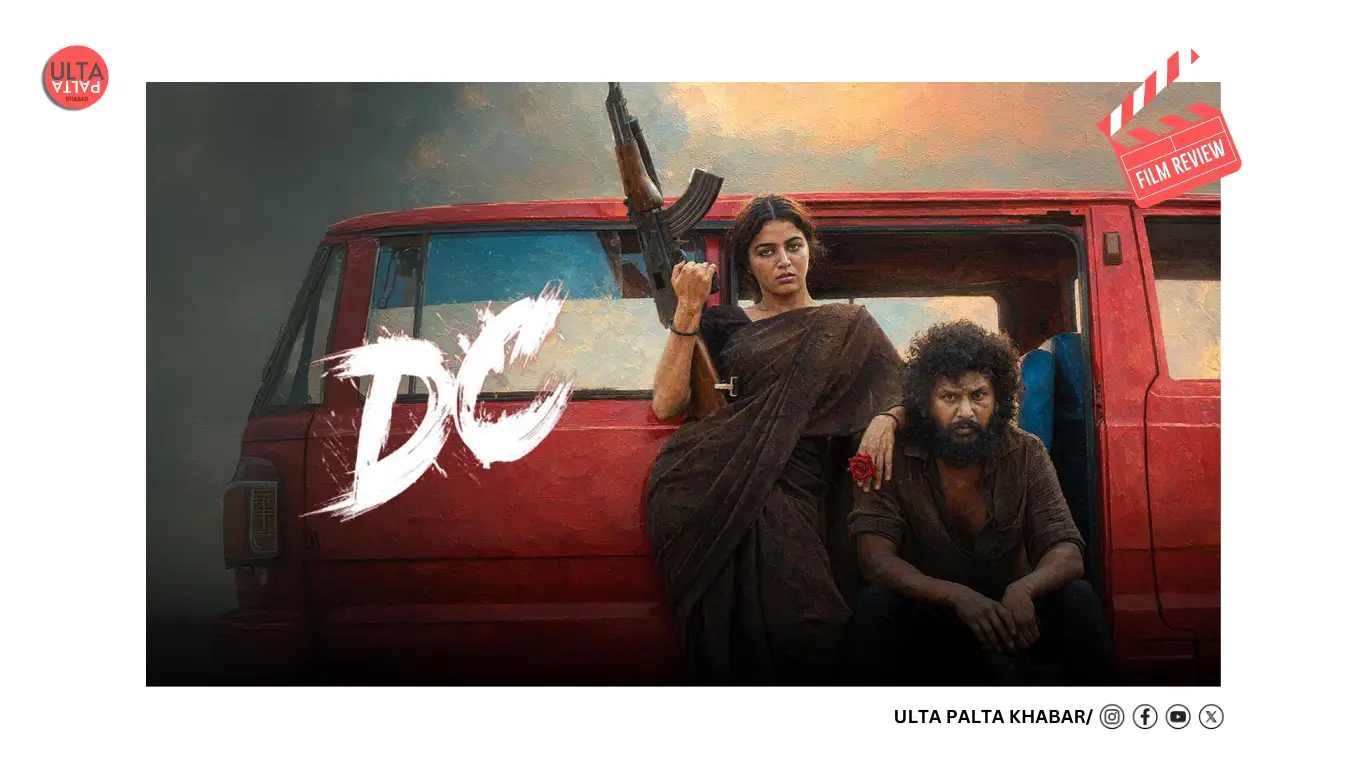

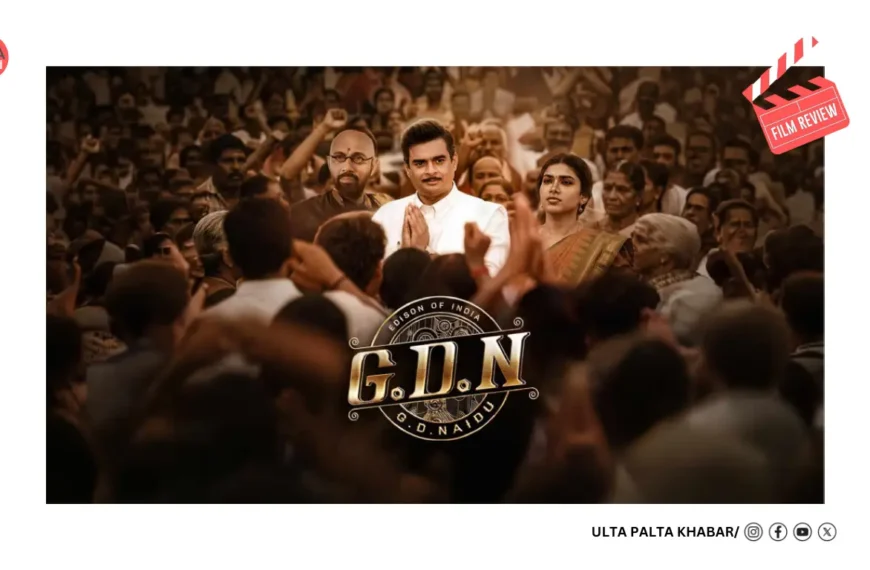
Arun Matheswaran turns the classic Devadas love story into a gritty gangster thriller, with Lokesh Kanagaraj making a surprisingly powerful acting debut alongside Wamiqa Gabbi and Anirudh Ravichander’s thunderous score.
There is a certain madness in taking a story as emotionally familiar as Devadas and throwing it into a world of guns, blood, gangsters, police chases and stolen weapons.
That is exactly what Arun Matheswaran attempts with DC.
Note: For optimal viewing on mobile devices, rotate the screen.
The Tamil romantic action drama, starring filmmaker-turned-actor Lokesh Kanagaraj as Devadas alias Das and Wamiqa Gabbi as Chandra, is not interested in delivering another conventional tragic-love story. Instead, it takes the emotional DNA of Devadas and rebuilds it inside a violent gangster universe where survival is as important as love.
The result is a film that is stylish, bloody, occasionally tender and, most importantly, far more interested in its damaged characters than its gangster plot might initially suggest.
DC was released theatrically on August 7, 2026, and carries an adults-only certification. The film runs for approximately 2 hours and 23 minutes. (Sun Pictures)
Note: For optimal viewing on mobile devices, rotate the screen.
DC Movie Review: This is not the Devadas you remember
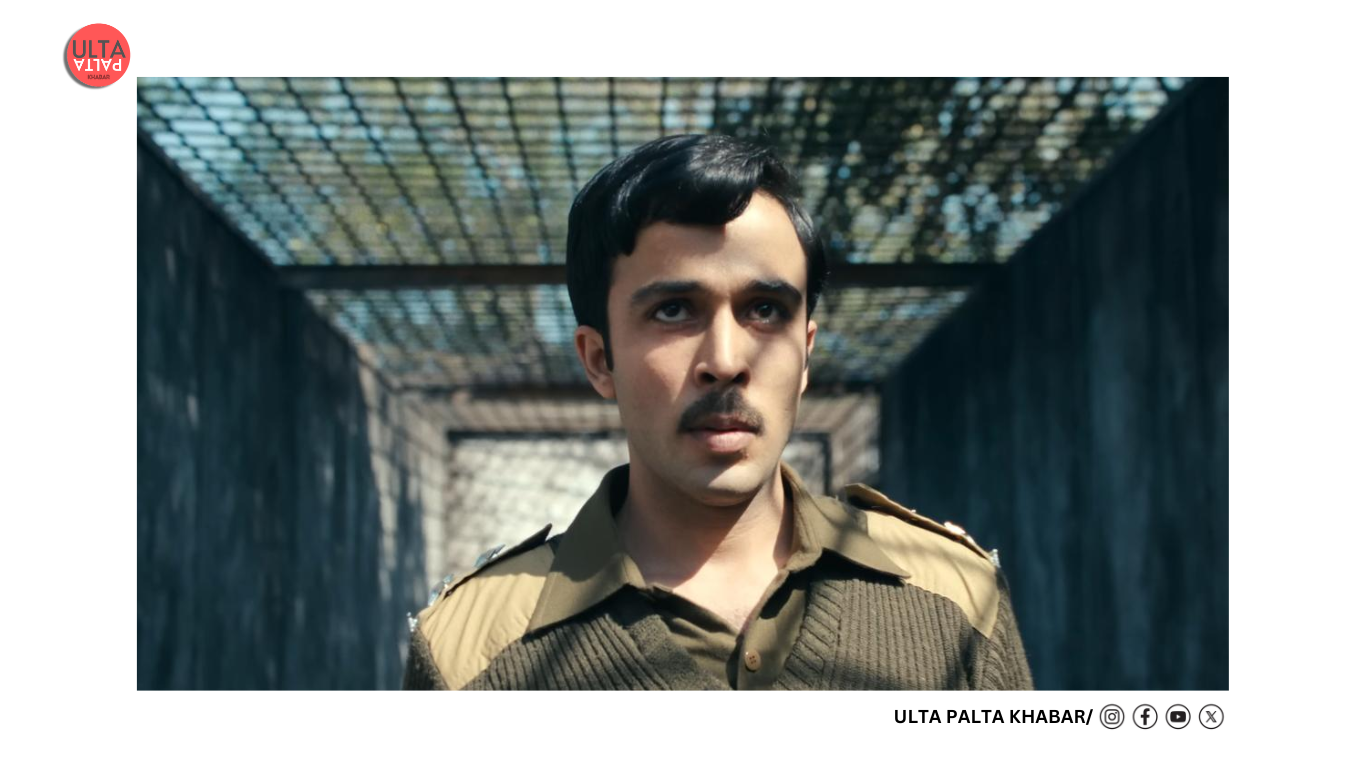
At the heart of DC is Devadas, or Das, a gangster who finds himself on the run after killing a police officer with a hammer and stealing a consignment of discarded weapons.
With his associates Kitty and Sebastian alongside him, Das moves from place to place while police officer Bhograj and his men hunt him down.
On paper, this sounds like a straightforward gangster chase.
It isn’t.
The film’s real interest lies in asking a much more human question: What happens when violent people desperately want a peaceful life?
That idea gives DC its emotional backbone.
Das isn’t simply running from the police. He is running from the life he has built.
And when he encounters Parvathy, a singer whose voice reminds him of his mother, the film briefly drops its guns and bloodshed for something much more intimate.
That fleeting relationship becomes important precisely because it feels normal.
For a man constantly surrounded by violence, a few hours of companionship suddenly feel like an entire lifetime.
Lokesh Kanagaraj’s acting debut is the biggest surprise
Let’s get the obvious question out of the way.
Can Lokesh Kanagaraj act?
Surprisingly, yes.
The celebrated filmmaker, known for directing films such as Kaithi, Vikram, Leo and Coolie, steps in front of the camera for the first time as the protagonist of DC. The official credits confirm that he plays Devadas, while Wamiqa Gabbi plays Chandra. (Sun Pictures)
And rather than looking like a director awkwardly attempting to become an actor, Lokesh settles into Das with unexpected confidence.
His performance relies heavily on body language.
He doesn’t constantly explain Das’s pain through dialogue. Instead, there is a certain heaviness in his eyes and physical stillness that communicates the character’s exhaustion.
That works beautifully in the quieter scenes.
When Das isn’t shooting somebody, running from the police or fighting for his life, Lokesh gets an opportunity to show another side of the character.
And those moments are arguably where his performance becomes most convincing.
His action scenes also carry physical intensity. There is nothing particularly polished about Das’s violence. It feels messy, desperate and personal.
For someone making his acting debut, Lokesh has pulled off something rather difficult: he makes us forget that he is Lokesh Kanagaraj.
That is perhaps the biggest compliment an actor can receive.
Wamiqa Gabbi gives DC its emotional pulse
If Lokesh provides the film’s controlled intensity, Wamiqa Gabbi provides its emotional unpredictability.
As Chandra, she plays a woman who has spent 18 years trapped in an exploitative existence.
Her character could easily have become a conventional victim waiting for a hero to rescue her.
Thankfully, the film gives her more agency than that.
Chandra is damaged, suspicious and emotionally guarded, but she is also strong.
Her relationship with Das works because it isn’t immediately presented as a traditional romance.
These are two people who understand loneliness.
They don’t necessarily fall in love because they are perfect for each other. They connect because they recognise something broken in one another.
That makes their chemistry considerably more interesting.
Wamiqa’s performance ensures that Chandra isn’t simply an extension of Das’s story. She has her own pain, history and desire for freedom.
Sanjana Krishnamoorthy makes a brief appearance count
Sanjana Krishnamoorthy plays Parvathy, the singer Das encounters in Coimbatore.
Her role is considerably smaller than Wamiqa’s, but the character serves an important narrative purpose.
Parvathy represents the life Das might have wanted.
There is music.
There is peace.
There is companionship without violence.
And then reality comes crashing back.
The contrast between Parvathy and Chandra is deliberate. One represents a brief glimpse of normalcy; the other becomes a companion in the dangerous journey toward finding it.
That emotional contrast adds depth to Das’s character.
Arun Matheswaran brings his trademark violence
Arun Matheswaran has built a reputation for creating films with distinctive visual identities and brutal action.
DC continues that tradition.
The violence isn’t simply inserted to make the film look “mass.”
It is part of the world.
Blood, weapons, rough locations and morally compromised characters create an atmosphere in which tenderness itself feels dangerous.
There are moments when the film feels like a stylish crime saga, with shades of the heightened energy associated with international gangster cinema.
But Matheswaran’s greatest achievement is that he doesn’t allow the action to completely swallow the characters.
The film repeatedly returns to the desire for an ordinary life.
That is what keeps DC emotionally grounded.
The visual details are doing more work than you think
One of the film’s more enjoyable qualities is its attention to visual characterisation.
Chandra’s styling, including her saree, red lipstick and flower in her hair, evokes the visual memory of iconic South Indian screen femininity.
Her room is another example.
The presence of artistic references, including imagery reminiscent of Van Gogh and Salvador Dalí, gives the space a personality of its own.
Das, meanwhile, has his own visual markers, including the silver kada that becomes part of his appearance.
These aren’t enormous storytelling devices.
But they help make the characters feel designed rather than randomly dressed.
That attention to detail is one of Matheswaran’s strengths.
Anirudh Ravichander nearly steals the movie
Then there is Anirudh Ravichander.
The background score is one of DC‘s biggest assets.
The film already has violence, but Anirudh’s music gives that violence an additional pulse.
Action sequences become bigger.
Emotional moments become heavier.
Even scenes that might have otherwise felt ordinary acquire an unusual intensity.
Early audience reactions have particularly highlighted Anirudh’s score as one of the film’s major strengths.
This is not music sitting politely in the background.
It is actively participating in the storytelling.
Where DC stumbles
DC isn’t perfect.
Its biggest challenge is that the gangster mechanics occasionally become more interesting than the emotional development.
The stolen weapons, police pursuit and criminal world provide momentum, but some viewers may find the plot familiar once the initial novelty wears off.
There are also stretches where the film’s stylistic confidence threatens to overwhelm its emotional subtlety.
Matheswaran clearly knows how to create an image.
The question is whether every image needs to announce itself.
At times, the film feels slightly too conscious of its own coolness.
That said, the emotional core largely saves it.
The box office story has already begun
The Lokesh Kanagaraj factor has clearly helped create curiosity around the film.
Early box-office reporting indicates that DC opened to around ₹4.10 crore in India on its first day, with worldwide gross reported at approximately ₹5.70 crore.
Those numbers will become much more meaningful over the coming weekend.
The film has a few major advantages: Lokesh’s enormous fan base, Arun Matheswaran’s cult following, Wamiqa Gabbi’s growing popularity and Anirudh’s musical pull.
The challenge is whether strong word of mouth can turn initial curiosity into sustained theatrical momentum.
What DC could mean for Lokesh Kanagaraj’s future
The biggest consequence of DC may not be its box office.
It could be Lokesh Kanagaraj’s transition into acting.
If audiences continue responding positively to his performance, filmmakers may start looking at him not merely as a director who occasionally appears on screen, but as a viable actor.
That could open an entirely new chapter in his career.
But there is another side to it.
Lokesh is already one of Tamil cinema’s most commercially important filmmakers. Acting could potentially become a distraction from his directorial commitments if he chooses to pursue both aggressively.
For now, however, DC proves that the experiment wasn’t a gimmick.
He can act.
And more importantly, he can carry a film.
Final Verdict
DC is a gritty, stylish and emotionally bruised gangster drama that successfully gives the Devadas story a contemporary makeover.
Arun Matheswaran’s direction gives the film its identity. Lokesh Kanagaraj delivers a surprisingly assured acting debut. Wamiqa Gabbi brings emotional weight and strength to Chandra, while Sanjana Krishnamoorthy makes her limited screen time count.
But the film’s secret weapon is its emotional idea.
These aren’t people simply looking for love.
They are people looking for a normal life.
And in the brutal world of DC, normality is perhaps the most difficult thing to steal.
Ulta Palta Khabar Rating: 4/5
Verdict: Stylish, violent and unexpectedly tender. Lokesh Kanagaraj’s acting debut is the headline, but Arun Matheswaran’s emotional gangster drama is what makes DC worth watching.
Note: For optimal viewing on mobile devices, rotate the screen.
You May Like:
- ultapaltakhabar.com/dharman-rajinikanth-becomes-the-deadly-doctor-as-kamal-haasans-dream-project-finally-takes-shape-after-years-of-delays/
- ultapaltakhabar.com/bts-leader-rm-creates-history-kim-namjoon-becomes-first-ever-global-ambassador-of-national-museum-of-korea-army-celebrates-another-iconic-milestone/
- https://ultapaltakhabar.com/south-korean-box-office-colony-dominates-again-as-spielbergs-disclosure-day-opens-strong-korean-cinema-faces-new-challenge/
- ultapaltakhabar.com/ranveer-singh-gets-massive-relief-as-fwice-revokes-boycott-poonam-dhillon-reveals-actors-father-personally-thanked-her/



 By
By