
Donkey Princess Review: Cristóbal León and Joaquín Cociña return with a visually astonishing Chilean fantasy that mixes live action, handcrafted animation and dark fairytale horror — even if its story struggles to match the brilliance of its imagery.
There are fairytales that put you to sleep.
And then there are fairytales that make you question your childhood.
Donkey Princess, the latest feature from Chilean filmmaking duo Cristóbal León and Joaquín Cociña, firmly belongs to the second category.
Note: For optimal viewing on mobile devices, rotate the screen.
Premiering in the International Competition at the 2026 Locarno Film Festival, Donkey Princess is a strange, gorgeous and occasionally unsettling fantasy that takes the bones of Charles Perrault’s Donkeyskin and throws them into a kaleidoscopic universe of stop-motion animation, live-action photography, handmade sets, puppetry and surreal imagery. The film is a 90-minute Chilean-French-Uruguayan-Dutch-German co-production starring Antonia Giesen, Andrew Bargsted and Francisco Melo.
And yes, the title sounds like something you might find on a children’s bookshelf.
Don’t be fooled.
This is a fairytale for adults who have survived the family dinner table.
Note: For optimal viewing on mobile devices, rotate the screen.
Donkey Princess Review: A princess trapped by her father
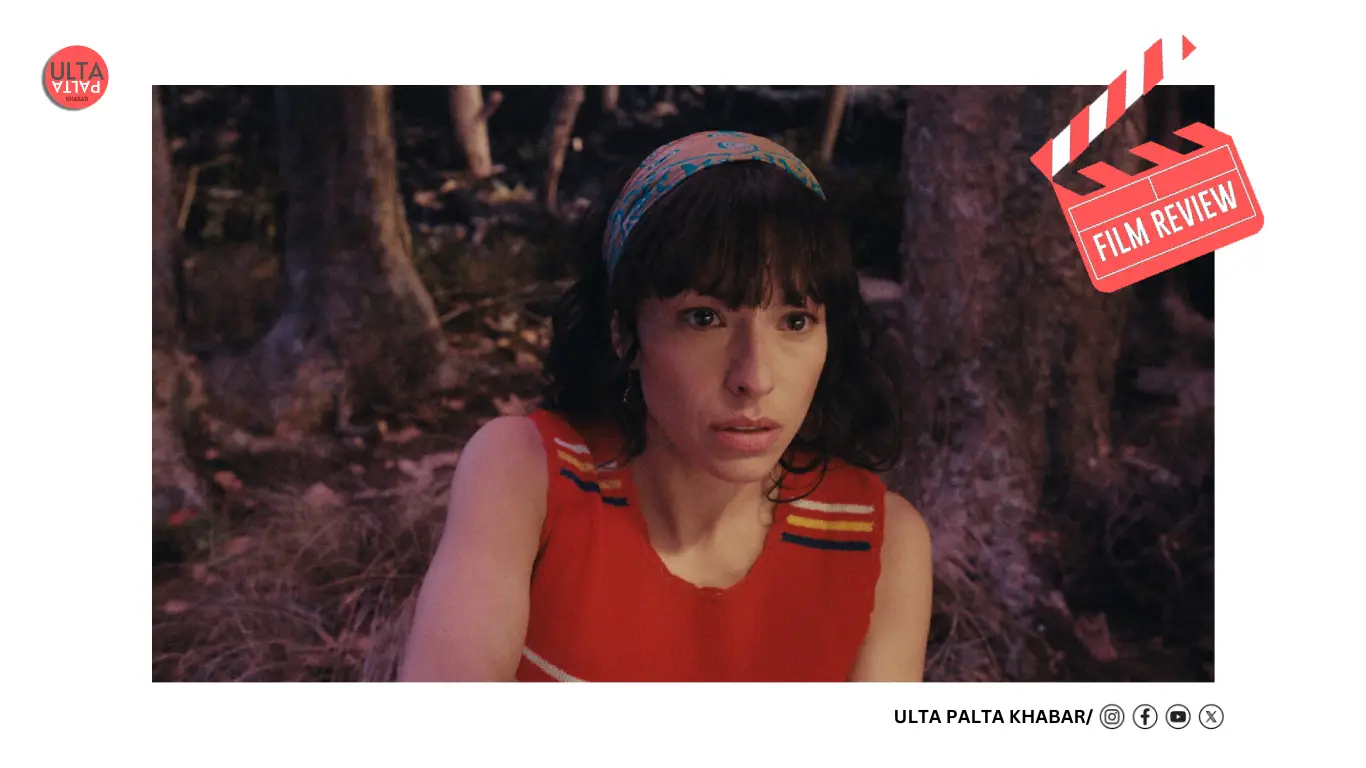
At the centre of the story is Princess Diana, played by Antonia Giesen.
No, she isn’t that Diana.
This Diana lives in a strange kingdom where love itself has effectively become forbidden. Her father, King Arthur, has become increasingly controlling following the death of his wife and keeps his daughter under suffocating protection.
Then Diana meets Lalo, a charming commoner played by Andrew Bargsted.
Naturally, the King isn’t exactly thrilled.
Their relationship becomes an act of rebellion, and Lalo is banished. But before leaving, he gives Diana a magical bracelet capable of granting wishes across time and space.
That bracelet becomes the film’s ticket out of the kingdom — and into something much stranger.
Diana is transported into contemporary Chile, where the fairytale princess finds herself attempting to build an ordinary existence with Lalo.
Except there is one gigantic problem.
Her father comes along for the ride.
And even without his kingdom, crown and authority, he remains capable of haunting her life.
The official synopsis similarly describes Diana’s journey through different worlds and parallel spaces as she tries to reclaim her dreams and lost love.
The Wolf House filmmakers are back — and still making nightmares beautiful
For anyone familiar with The Wolf House, the appeal of Donkey Princess will be immediately recognisable.
León and Cociña don’t simply create sets.
They create entire physical universes.
Their cinema has always occupied the bizarre space between animation, sculpture, theatre and live action. The filmmakers have been collaborating since 2007, and their work is known for combining photography, drawing, sculpture and performance with handmade visual techniques.
Their first feature, The Wolf House, premiered at the Berlin Film Festival and won the Caligari Prize. Their short The Bones later received the Orizzonti award for Best Short Film at Venice, while The Hyperboreans appeared at Cannes’ Directors’ Fortnight in 2024
So Donkey Princess isn’t simply another fantasy film.
It is the latest chapter in an increasingly recognisable cinematic language.
And visually, it is spectacular.
A kingdom that looks like it was built inside a fever dream
The fictional kingdom has the charming appearance of something that shouldn’t exist but somehow does.
There are castle towers resembling oversized toadstools, strange mountains, forests made from branches and deliberately imperfect handmade textures.
The production design by Natalia Geisse gives the film an intentionally artificial quality.
That is important.
A Hollywood fantasy would probably spend millions trying to make a fantasy kingdom look real.
León and Cociña do almost the opposite.
They make it look handmade.
And somehow that makes it more believable.
The turquoise and puce colour palette creates a sickly, dreamlike atmosphere, while the combination of tactile sets and animation gives the kingdom a sense that it could collapse at any moment.
It is beautiful.
It is also slightly creepy.
Exactly the way a good fairytale should be.
From royal fantasy to pest-control workers
The film’s biggest narrative gamble comes after Diana leaves her kingdom.
Suddenly, we’re not entirely in a medieval fantasy anymore.
Diana and Lalo find themselves in contemporary Chile, working together in the pest-control business.
Yes, you read that correctly.
The princess and her forbidden lover essentially go from royal court to exterminators.
It sounds ridiculous.
But that absurdity is part of the film’s charm.
Their supposed happily-ever-after isn’t actually happy. The couple has escaped one reality, but Diana hasn’t escaped her psychological baggage.
And then her father arrives.
Now stripped of his royal power and reduced to an ageing, dependent figure, the King is no longer physically ruling a kingdom.
But emotional control doesn’t disappear simply because the crown does.
That becomes the real monster of Donkey Princess.
The film’s biggest theme isn’t romance — it’s escape
At first glance, Donkey Princess looks like a love story.
But the deeper story is about escaping control.
Diana wants Lalo.
But more importantly, she wants ownership of her own life.
That makes the film’s use of the Donkeyskin fairytale particularly effective. The original tale has long carried uncomfortable themes surrounding a daughter’s relationship with her father and patriarchal possession.
León and Cociña don’t simply modernise that material.
They turn it into a psychological maze.
Diana keeps changing worlds, identities and circumstances, but the emotional problem follows her.
Different universe.
Same trauma.
Different life.
Same cage.
Antonia Giesen carries the surreal journey
Antonia Giesen is the film’s emotional centre.
Playing Diana requires her to navigate wildly different registers.
She must be convincing as a fairytale princess, a woman searching for freedom, a romantic partner and someone psychologically struggling to escape the influence of her father.
The performance works because Giesen doesn’t attempt to make Diana permanently mysterious.
There is vulnerability underneath the surrealism.
Her desire for an ordinary life gives the audience something recognisable to hold onto while everything around her becomes increasingly bizarre.
Andrew Bargsted’s Lalo provides the warmer counterpoint, representing the possibility of love without domination.
Meanwhile, Francisco Melo gives the King the kind of unsettling presence the role requires.
He doesn’t need to behave like a conventional cinematic villain.
His power comes from the fact that Diana has internalised his influence.
The opening is deliberately chaotic — perhaps too chaotic
This is where Donkey Princess starts losing some of its magic.
The filmmakers have created a universe so visually distinctive that the story sometimes struggles to keep pace.
The opening stretch is particularly hurried.
Ideas, characters and worlds arrive quickly, and viewers may need time to understand exactly what kind of film they’ve entered.
The film gradually becomes more graceful and coherent, but its storytelling remains deliberately opaque.
For viewers looking for conventional fantasy storytelling, this could become frustrating.
For fans of experimental cinema, however, the ambiguity is part of the attraction.
The final act changes everything
One of the film’s boldest decisions comes near the end.
After spending much of its runtime constructing handmade fantasy worlds, Donkey Princess moves increasingly toward realism.
That transition is startling.
And strangely moving.
Suddenly, the film’s artificiality begins to disappear, leaving its characters exposed without the protection of elaborate sets and animation.
The effect is almost like waking up from a nightmare.
Except you’re not sure whether waking up is actually better.
That tonal shift is arguably the film’s most interesting formal decision.
Jean-Benoît Dunckel adds another layer to the dream
The music by Jean-Benoît Dunckel complements the film’s strange visual language without overpowering it.
Rather than turning the fantasy into conventional spectacle, the soundscape helps maintain the feeling that the characters are moving through unstable realities.
It contributes to the film’s dreamlike quality while allowing the quieter emotional passages room to breathe.
Can Donkey Princess become the duo’s next festival sensation?
That may be the most interesting question.
Donkey Princess has already arrived with a major festival platform: it is part of the 2026 Locarno International Competition.
That matters because León and Cociña have established themselves as filmmakers whose work travels particularly well through the international festival and art-cinema circuit.
The film’s handmade aesthetic could also make it attractive to audiences interested in experimental animation, alternative fantasy and auteur cinema.
But there is a commercial ceiling.
This isn’t four-quadrant fantasy entertainment.
It is strange, sexually uncomfortable, psychologically loaded and formally adventurous.
That will limit its mainstream appeal.
At the same time, that very strangeness could make it a cult favourite.
And honestly, Donkey Princess feels destined for a cult following.
Final Verdict
Donkey Princess is an extraordinary visual experience wrapped around a slightly less extraordinary story.
Cristóbal León and Joaquín Cociña once again prove that they can create worlds that look as though they have crawled directly out of someone’s subconscious.
The handmade animation, surreal production design and mixture of live action and tactile imagery are the real stars.
The story takes longer to settle, and the opening can feel confusingly compressed. It also doesn’t quite achieve the devastating emotional intensity of The Wolf House.
But Donkey Princess remains fascinating because it is clearly the work of filmmakers refusing to repeat themselves.
It takes the classic fairytale, adds incestuous undertones, patriarchal trauma, parallel worlds, contemporary Chile, romance and surreal animation, throws everything into a blender and somehow comes out with something coherent.
Mostly.
And that’s exactly why it deserves attention.
Ulta Palta Khabar Rating: 3.5/5
Verdict: A visually hypnotic, psychologically unsettling fairytale that may not haunt you as deeply as The Wolf House, but its handmade nightmares, strange humour and fractured story make Donkey Princess impossible to ignore.
The film’s official international title is Donkey Princess, while its original Spanish title is Princesa Burro. It is currently listed as a 2026 fantasy feature from Chile, France, Uruguay, the Netherlands and Germany.
Note: For optimal viewing on mobile devices, rotate the screen.
You May Like:
- ultapaltakhabar.com/dharman-rajinikanth-becomes-the-deadly-doctor-as-kamal-haasans-dream-project-finally-takes-shape-after-years-of-delays/
- ultapaltakhabar.com/bts-leader-rm-creates-history-kim-namjoon-becomes-first-ever-global-ambassador-of-national-museum-of-korea-army-celebrates-another-iconic-milestone/
- https://ultapaltakhabar.com/south-korean-box-office-colony-dominates-again-as-spielbergs-disclosure-day-opens-strong-korean-cinema-faces-new-challenge/
- ultapaltakhabar.com/ranveer-singh-gets-massive-relief-as-fwice-revokes-boycott-poonam-dhillon-reveals-actors-father-personally-thanked-her/

 By
By