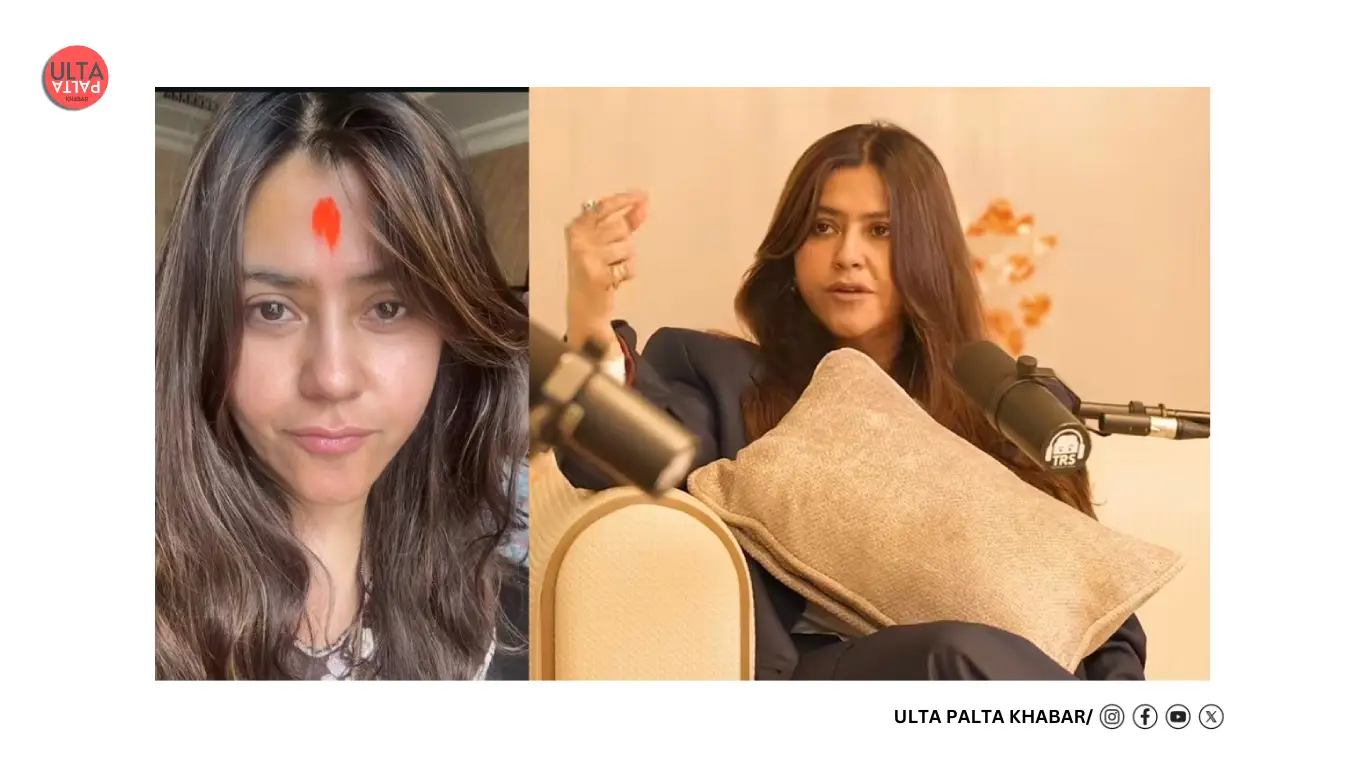

Speaking on Ranveer Allahbadia’s podcast, Ektaa Kapoor questions the entertainment industry’s attitude towards Hindu folklore and mythology, recalls being judged for wearing a tika and dhaaga, and links the conversation to her folklore-inspired film The Vvaan – Force of the Forrest.
Ektaa Kapoor has sparked a fresh conversation about religion, identity and creative freedom in the entertainment industry. The television and film producer, known for backing some of Indian entertainment’s biggest shows and films, has spoken candidly about what she describes as “Hinduphobia” in the industry, questioning why Hindu folklore and mythology can attract resistance even as Western fantasy and animation find mainstream acceptance.
Note: For optimal viewing on mobile devices, rotate the screen.
During a conversation with Ranveer Allahbadia on his podcast, Kapoor opened up about the challenges of bringing Indian folklore to the screen. She also recalled being judged for openly displaying her religious identity, including wearing a tika and dhaaga. Her remarks have put the spotlight on a larger question: does the entertainment industry give stories rooted in Indian faith and traditions the same space it gives other cultural narratives?
Note: For optimal viewing on mobile devices, rotate the screen.
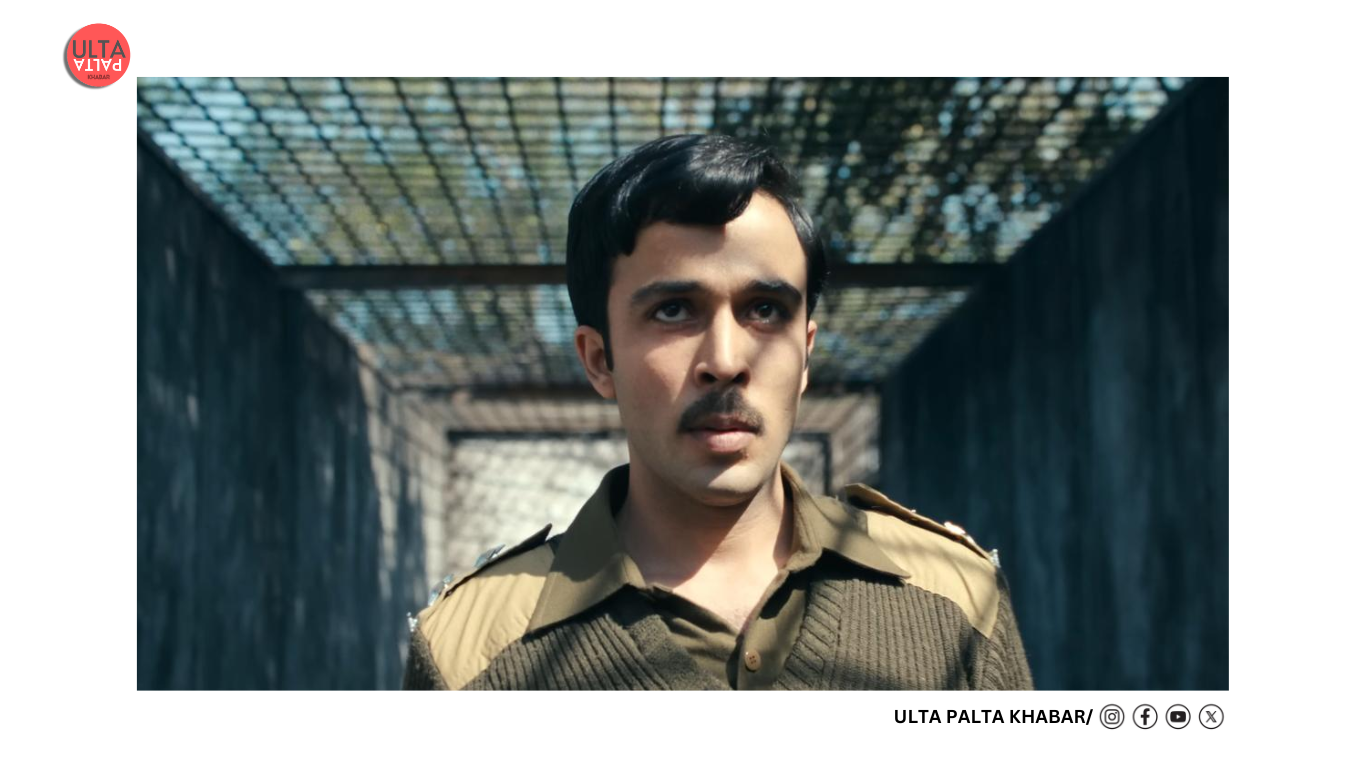
The discussion comes in the wake of The Vvaan – Force of the Forrest, the folklore-inspired film produced by Kapoor that arrived in cinemas on September 25, 2026. With Sidharth Malhotra and Tamannaah Bhatia leading the cast, the film draws on supernatural elements and folklore associated with a forest and the deity Van Devi.
Ektaa Kapoor Says Bollywood Needs to Rethink Its Attitude Towards Hindu Folklore
Kapoor did not mince words while discussing the reception of stories inspired by Indian traditions. Speaking about the importance of folklore in cinema, she said, “Numbers are great for the film. What is really important is it deals with folklore.”
She then described what she sees as a deeper problem in the entertainment industry, saying, “Hinduphobia, and we have so much of phobia with what do we call… We’re okay with animated animation, but we’re not okay with discussing folklore and mythology.”
Her argument centres on the contrast between the acceptance of fantasy as a genre and the hesitation she believes can emerge when stories draw directly from Hindu mythology or Indian religious traditions.
For Kapoor, folklore is not merely a commercial ingredient or a convenient backdrop for a supernatural thriller. It can be a way of bringing local beliefs, cultural memory and traditional storytelling to a wider audience. She also expressed optimism about changing attitudes, adding that she was comfortable bringing such stories into the public conversation and felt there was now greater acceptance.
Her remarks are likely to generate debate across the industry. Some viewers may agree that Indian mythology deserves more ambitious, mainstream storytelling, while others may argue that the success of any film depends on its writing, direction and execution rather than its cultural subject alone.
That distinction matters. Kapoor has expressed her perspective on a perceived bias; her comments do not, by themselves, establish that the entire entertainment industry discriminates against Hindu stories. But they have raised a question worth discussing: are filmmakers equally willing to take creative risks with stories rooted in India’s diverse cultural traditions?
‘Wearing a Tika and Dhaaga Is Such a Problem’: Producer Recalls Being Mocked
The conversation became more personal when Kapoor discussed her experiences of displaying her faith in everyday life.
The producer recalled being called a “freak” when she was younger because she wore a tika and dhaaga. She described the experience of openly expressing religious identity as something that could invite unwanted attention and judgement.
“I can’t even tell you. Wearing a tika and wearing your, your religion on your sleeve is such a problem,” she said.
Kapoor also remembered going to a club directly after visiting a mandir and being met with surprise by people who questioned whether she had visited a temple.
Her response was straightforward: “Yeah.” She then questioned why the act was considered shocking.
The anecdote touches on a familiar social expectation: that spirituality and a modern lifestyle must belong in separate boxes. A person may be expected to choose between traditional religious practices and an urban, contemporary identity, even though many people move comfortably between the two.
Kapoor’s recollection challenges that assumption. Visiting a temple, wearing religious symbols, working in entertainment and going out socially are not necessarily contradictory choices. Her point was that displaying faith should not automatically become a reason for ridicule.
Her experience also highlights how public figures can face scrutiny over personal choices that have little to do with their professional work. For a producer whose career involves making decisions about stories, performers and audiences, the ability to express her own beliefs without being reduced to them is an important part of the conversation.
At the same time, the broader debate should leave room for individual experiences rather than treating every disagreement over religious storytelling as evidence of prejudice. The challenge for the industry is to create space for different cultural perspectives while allowing films to be evaluated honestly on their artistic merits.
How The Vvaan – Force of the Forrest Fits Into the Debate
Kapoor’s comments are particularly relevant because The Vvaan – Force of the Forrest places folklore and supernatural mythology at the centre of its story.
Directed by Deepak Kumar Mishra, the film stars Sidharth Malhotra and Tamannaah Bhatia, with Anup Soni, Sunil Grover, Shweta Tiwari and Maniesh Paul among the supporting cast.
The story follows a modern, rational man whose return to his ancestral village draws him into an old legend surrounding a forbidden forest and a divine presence. The film combines fantasy, mystery, action and supernatural elements, using local folklore to build its cinematic world.
Its approach reflects a growing interest in Indian stories that move beyond familiar urban settings and draw on regional legends, deities, village traditions and supernatural beliefs. Films such as Kantara have demonstrated that culturally rooted narratives can connect with audiences when their storytelling creates a strong sense of place and emotional investment.
However, cultural relevance alone does not guarantee critical acclaim. Reviews of The Vvaan – Force of the Forrest have been mixed, with critics acknowledging its folklore-driven premise while raising concerns about aspects of its execution and narrative structure.
That makes the film an interesting case study. Kapoor’s argument concerns the space given to folklore, while the film’s reception also illustrates the importance of how such material is translated into cinema. A story can be culturally distinctive and still face legitimate questions about pacing, character development, visual effects or screenplay.
For filmmakers, the opportunity lies in combining authenticity with compelling storytelling. Respecting a tradition and creating a gripping film need not be competing goals.
Could Ektaa Kapoor’s Remarks Influence Bollywood’s Next Wave of Mythology Films?
Kapoor’s comments arrive at a time when Indian entertainment continues to explore mythology, folklore, fantasy and stories inspired by regional traditions. For producers, these subjects offer opportunities to build distinctive cinematic worlds and connect younger viewers with narratives that have travelled through generations.
Her intervention may encourage more open discussions about which stories receive investment, how religious traditions are represented, and whether creators feel comfortable exploring culturally specific material without anticipating ridicule.
The commercial implications could also be significant. Folklore can provide filmmakers with recognisable cultural foundations while allowing them to develop original characters, visual styles and fictional worlds. When handled thoughtfully, these stories can appeal to audiences in India and potentially find viewers overseas who are curious about Indian mythology.
But the next step is not simply to produce more films about religion. The industry must also invest in research, nuanced writing, strong performances and effective visual storytelling. Audiences may be drawn to a film because of its cultural roots, but they still expect an engaging cinematic experience.
Kapoor’s comments could therefore contribute to two parallel conversations: whether Hindu folklore receives fair consideration as a storytelling tradition, and what it takes to turn that folklore into successful screen entertainment.
The industry’s response will be measured less by statements alone and more by the range of projects that eventually receive funding, reach cinemas and find audiences.
Ektaa Kapoor’s Message: Faith and Modernity Can Coexist
For now, Kapoor’s remarks have placed her personal experiences and creative ambitions at the centre of a wider cultural discussion. Her recollection of being mocked for wearing a tika and dhaaga gives the debate a personal dimension, while her defence of folklore connects it to the choices producers make about the stories they bring to the screen.
Whether everyone agrees with her use of the term “Hinduphobia” or not, the questions she has raised are likely to remain relevant: Can people express their religious identity without being stereotyped? Can filmmakers explore Hindu mythology without their intentions being dismissed? And can the industry make room for culturally rooted stories while maintaining the same standards of creative criticism applied to every other genre?
For Kapoor, the answer begins with greater acceptance. Her experience suggests that faith should not be treated as incompatible with a contemporary lifestyle, just as folklore should not be automatically dismissed as a subject for cinema.
As Indian filmmakers continue to experiment with mythology and supernatural storytelling, the real test will be whether these narratives receive both the creative freedom and the craftsmanship they need to flourish. The debate sparked by Kapoor may be uncomfortable for some, but it has brought an important question into focus: who gets to tell India’s stories, and how much room does the industry give them to do so?
Note: For optimal viewing on mobile devices, rotate the screen.
You May Like:
- ultapaltakhabar.com/hanuman-ansh-misses-oscar-deadline-inr-2-crore-film-crosses-inr-205-crore-as-makers-reveal-why-indias-official-entry-dream-was-lost/
- ultapaltakhabar.com/tamil-cinema-faces-september-shutdown-no-new-tamil-film-releases-from-september-1-as-producers-clash-with-theatre-owners-over-8-week-ott-rule/
- https://ultapaltakhabar.com/cinemark-backs-111-billion-paramount-warner-bros-merger-as-all-major-u-s-theater-chains-line-up-behind-david-ellison/
- ultapaltakhabar.com/oscars-2027-budget-youtube-move-and-ai-debate-academy-reveals-its-big-plans-for-hollywoods-future/

 By
By