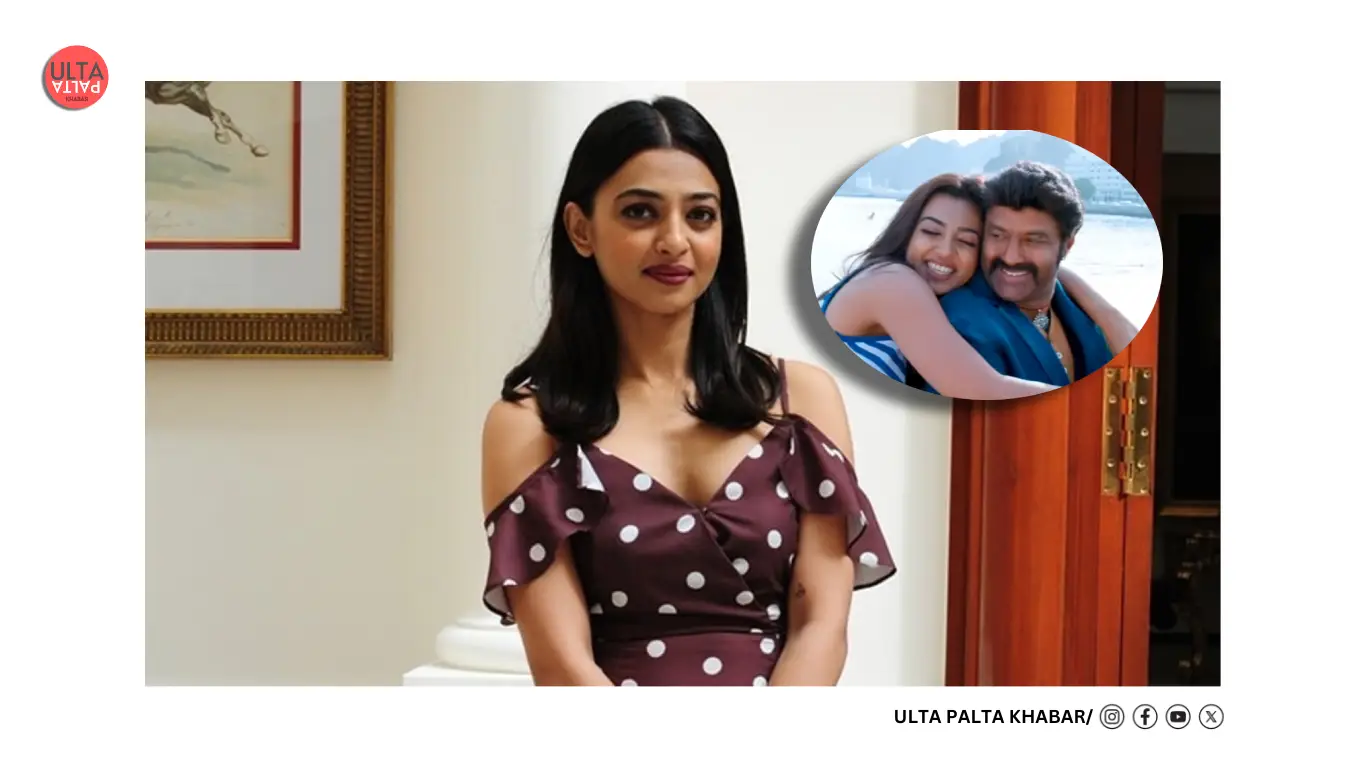

The actor says she hated a Telugu film that required her to romance a much older co-star and play a character who dies midway. Although she did not name the film, social media users have identified it as the 2014 blockbuster Legend.
Actor Radhika Apte has found herself at the centre of a fresh social media controversy after speaking candidly about an uncomfortable experience on a Telugu film set. The actress, who has often voiced her views on gender inequality and working conditions in the entertainment industry, recalled a role that she described as one of the most challenging experiences of her career. Her comments have now triggered a heated debate, with some viewers supporting her perspective and others accusing her of criticising Telugu cinema years after benefiting from a successful film.
Note: For optimal viewing on mobile devices, rotate the screen.
The discussion began after a clip from Radhika’s recent conversation with Zoom went viral. The actor was promoting her latest project, Akka, alongside co-star Keerthy Suresh when she was asked about the most challenging role she had played.
Radhika recalled working in a Telugu film in which her character had to marry her maternal uncle. She did not hold back while describing her experience, saying, “There was a Telugu film I did where I had to marry my Mama (maternal uncle) in the film. It was the most challenging film. I hated everything about it.”
Note: For optimal viewing on mobile devices, rotate the screen.
Keerthy, who appeared surprised by the revelation, stepped in to explain the cultural context of such relationships in certain traditional South Indian communities. She remarked, “It’s a very Tamil and Telugu thing where you marry your uncle.”
However, Radhika made it clear that the storyline was not her only concern. She also spoke about the age difference between her character and the male actor, as well as the way her character was treated in the narrative.
“But I also had to romance a much older actor. It was a very patriarchal situation and place, and for me that was the toughest thing. And then I die in the middle of it. He had to throw me (gestures over her shoulder) and then do action. I was like, ‘When am I going to die?'” she said.
Her description quickly caught the attention of social media users, who began trying to identify the film.
Why Are Netizens Linking Radhika Apte’s Comments to Legend?
Although Radhika did not mention the film’s title, many viewers believe she was referring to director Boyapati Srinu’s 2014 Telugu action drama Legend, featuring Nandamuri Balakrishna in the lead role.
The speculation is not entirely surprising. Radhika appeared opposite Balakrishna in Legend and later reunited with him for the 2015 film Lion. Reports examining her Telugu filmography have also pointed out that she worked with Balakrishna in two of her Telugu projects.
The age difference has become another major talking point. Balakrishna was 54 when Legend was released in 2014, while Radhika was 29. Her reference to romancing a considerably older actor has therefore led social media users to connect the dots.
However, there is an important detail that deserves attention. While Radhika described the relationship in her recollection using the word “Mama”, coverage examining Legend has pointed out that her character is connected to the male lead as his cousin and is romantically involved with him. In Telugu family terminology, bava can refer to a cousin or other male relative who may be considered a prospective spouse. The distinction matters because the relationship described in the film’s story should not automatically be presented as a marriage to the actor’s own maternal uncle.
The film identification has gained traction because of the details Radhika shared, but the actress herself has not explicitly confirmed the title in the interview.
Social Media Divided: Criticism, Questions and Support
As the interview clip circulated, reactions quickly turned into a debate about whether Radhika was justified in revisiting an experience that took place more than a decade ago.
Some users questioned why the actress accepted the project if she was uncomfortable with its storyline, casting or characterisation. One social media user argued that Radhika would have known the film’s story and lead actor before signing the project, and questioned why she was raising these concerns years later.
Another user pointed out that a significant section of Telugu audiences became familiar with Radhika through Legend. The user questioned the timing of her criticism and described it as ironic that she was now speaking negatively about an industry in which she had worked.
The criticism has also been fuelled by discussions around an older interview in which Radhika reportedly expressed gratitude for being part of Legend. Some users have brought that interaction back into the conversation, arguing that her present comments appear different from her earlier public remarks.
But the debate is not quite as simple as a question of whether an actor once expressed gratitude for a film. An actor can appreciate a project’s professional impact while also looking back critically at particular scenes, character choices or working conditions. Being part of a commercially successful film does not necessarily mean that every aspect of the experience was comfortable.
Equally, viewers are entitled to question the context of a public statement, particularly when the film and the people involved have not been directly named.
Radhika Apte’s Comments Revive the Debate on Patriarchy in Cinema
Beyond the speculation surrounding Legend, Radhika’s remarks have brought attention to a wider issue: the representation of women in commercial cinema.
For decades, several mainstream films across Indian industries have featured storylines involving significant age gaps between male and female leads. Female characters have also frequently been written around the male protagonist’s journey, with their romantic relationships, deaths or dramatic sacrifices serving as devices to advance the hero’s story.
Radhika’s recollection of being made to romance an older actor and then being killed off midway through the film touches on precisely this concern. Her description of the situation as patriarchal suggests that her discomfort was not limited to the age difference. It was also connected to the character’s position within the story and the way her role was handled.
Keerthy’s explanation about certain traditional marriage customs also opened another layer of discussion. Cultural practices and their portrayal in cinema are not necessarily the same thing. A storyline may draw from a regional tradition, but audiences and actors can still question how that tradition is represented, particularly when it involves gender, consent and power dynamics.
The conversation therefore extends beyond one film or one actor. It raises questions about how much agency female characters receive in commercial storytelling and whether actresses have enough room to challenge roles that make them uncomfortable.
What Could This Controversy Mean for Radhika Apte?
For Radhika, the immediate consequence is renewed attention, but not necessarily the kind that comes with a new release or a conventional promotional campaign. Her comments have brought an older project back into public conversation and placed her views on gender representation under a fresh spotlight.
The controversy could also lead to renewed scrutiny of her past interviews and performances, especially those connected to Telugu cinema. If she chooses to elaborate on the experience, audiences may get a clearer understanding of what specifically made the film difficult for her, whether it was the script, the character, the atmosphere on set or a combination of these factors.
At the same time, the discussion could become more polarised if the film’s identity continues to be treated as officially confirmed without a direct statement from the actress. It is important to distinguish between what Radhika actually said and what viewers have inferred from her description.
There is also a larger question for filmmakers. As conversations around gender representation and workplace dynamics become more prominent, actors may increasingly speak about roles and production environments that they once chose not to discuss publicly. Such conversations can encourage filmmakers to pay closer attention to character development, age dynamics and the agency given to women on screen.
Will Radhika Apte Clarify Which Film She Was Talking About?
For now, the biggest unanswered question remains the film’s identity. Social media users and several entertainment reports have linked Radhika’s description to Legend, but she has not named the movie in the viral interview. She has also not provided further details about the circumstances that made the experience so uncomfortable.
Neither the online criticism nor the renewed attention surrounding the 2014 film changes what she actually said: she disliked the experience and considered the situation patriarchal.
Whether Radhika decides to clarify the reference, address the backlash or leave the comments to speak for themselves remains to be seen. Until then, the discussion is likely to continue, with one section of the internet questioning her timing and another focusing on the larger issue she has raised.
More than a decade after Legend hit theatres, a candid recollection has unexpectedly brought the film back into the headlines. And this time, the conversation is not about its action sequences or box-office success, but about the experience of the actress who was part of its story.
Note: For optimal viewing on mobile devices, rotate the screen.
You May Like:
- ultapaltakhabar.com/anime-hits-4-45-trillion-yen-japans-cartoon-empire-is-now-a-rs-2-67-lakh-crore-monster-and-the-world-cant-stop-watching/
- https://ultapaltakhabar.com/trai-wants-a-licence-for-your-free-streaming-tv-what-the-new-rules-mean-for-fast-apps-smart-tvs-and-your-remote/
- ultapaltakhabar.com/netflixs-big-korea-bet-pays-off-squid-game-song-hye-kyo-and-gong-yoo-lead-k-content-push-amid-layoffs-and-leadership-shake-up/
- ultapaltakhabar.com/hollywoods-biggest-agencies-join-forces-against-netflix-disney-and-prime-video-american-entertainment-alliance-demands-50-budget-for-indie-productions/

 By