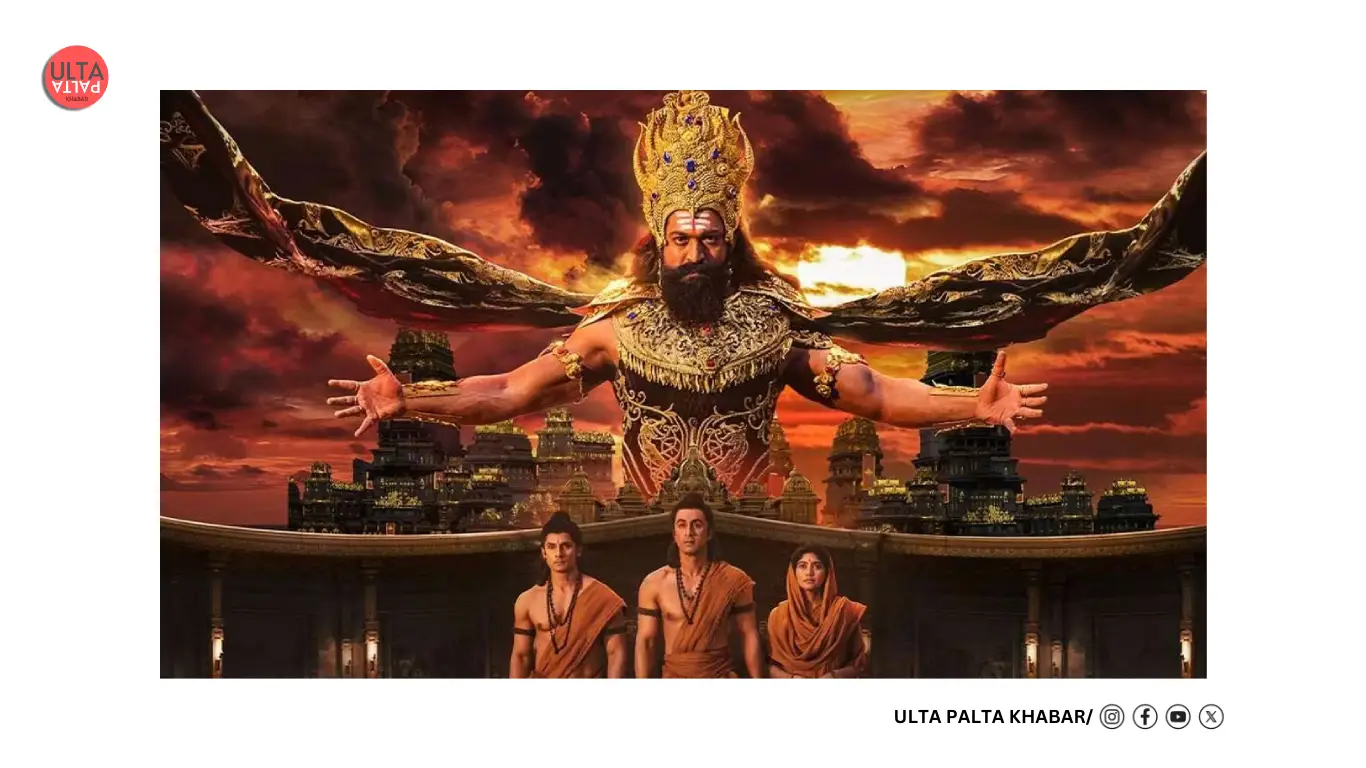

Yash’s commanding performance as Ravana has become one of the biggest talking points following Ramayana Part 1’s theatrical release. While fans are celebrating his screen presence, several viewers have accused the makers of glorifying the antagonist and overshadowing Lord Rama.
New Delhi: Nitesh Tiwari’s much-awaited Ramayana: Part 1 has finally arrived in theatres, but instead of everyone talking exclusively about Ranbir Kapoor’s portrayal of Lord Rama, it is Yash’s Ravana who has managed to grab a considerable share of the spotlight. The ambitious mythological spectacle, mounted on a reported combined budget of approximately ₹4,000 crore for its two instalments, has opened a fresh debate on social media, with audiences divided over the portrayal of one of Hindu mythology’s most complex antagonists.
Note: For optimal viewing on mobile devices, rotate the screen.
While Yash’s commanding screen presence, expressions and larger-than-life appearance have attracted considerable appreciation, another section of viewers is questioning whether the film has given Ravana too much prominence. The debate has quickly turned into an online discussion about the difference between presenting a powerful antagonist and glorifying his character.
Note: For optimal viewing on mobile devices, rotate the screen.
And interestingly, this controversy has also brought Ranbir Kapoor’s casting as Lord Rama back into the spotlight.
Yash’s Ravana Becomes the Biggest Talking Point After Ramayana Release
Ever since the casting announcements and promotional material of Ramayana generated excitement, Yash’s transformation into Ravana has been among the most anticipated aspects of the film. Known for his powerful performances in the KGF franchise, the actor has a considerable fan following, particularly among audiences who enjoy larger-than-life cinematic characters.
Now that the first instalment has reached cinemas, early audience reactions suggest that Yash has delivered a performance that is difficult to ignore.
Several viewers have praised his body language, expressions, commanding personality and the intensity he brings to the character. Some have even described him as the scene-stealer of the film.
However, the same appreciation has also triggered an unexpected discussion. Some moviegoers believe that the attention surrounding Ravana is becoming disproportionate to the central character of the Ramayana.
One social media user wrote, “Exactly what I doubted from day one came true. Total Ravana glorification in the film. It’s over, bro. #Ramayana”
Another viewer questioned the film’s central focus, commenting, “It seems in the name of #Ramayana they made #Ravana. Everyone is talking about the glorification of #Ravana.”
The user also suggested that Yash’s character had overshadowed Ranbir Kapoor’s portrayal of Lord Rama.
Another particularly critical reaction read, “Misleading an entire generation through the glorification of Ravana. Shame on Bollywood. Altering or presenting a selective narrative is not good for an epic.”
These reactions indicate that the discussion is no longer limited to acting performances. It has moved towards the larger question of how filmmakers should approach culturally significant mythological stories.
Yash Fans Have a Different Opinion: ‘Perfect Casting’
While some viewers are uncomfortable with the attention Ravana is receiving, Yash’s supporters are not ready to accept that the character’s popularity automatically means the film has glorified him.
For many fans, the actor’s performance is precisely what they expected from someone portraying the powerful king of Lanka.
One viewer wrote, “For the first time, I couldn’t find Rocking Star Yash in a #Yash movie. There was only the performer Yash visible. Those expressions, those eyes, that walk, those hand movements.”
Another enthusiastic fan simply reacted, “WHAT IS THIS MADNESS FOR YASH AS RAVANA?”
A third user went a step further, describing Yash’s casting as arguably one of the most suitable choices for the character in Indian cinema.
The appreciation highlights an important distinction: audiences can admire an actor’s portrayal of an antagonist without necessarily supporting the character’s actions or ideology.
Ravana is traditionally remembered as a formidable ruler, an accomplished scholar and a devotee of Lord Shiva, but his abduction of Goddess Sita and his refusal to return her remain central to his downfall in the epic.
Consequently, presenting his intelligence, royal stature and military strength on screen is not automatically equivalent to celebrating his wrongdoing. The real question is whether the narrative maintains the moral distinction between his extraordinary abilities and his decisions.
Ranbir Kapoor’s Lord Rama Now Faces a Different Challenge
Interestingly, the conversation surrounding Yash has also created an additional challenge for Ranbir Kapoor.
Playing Lord Rama is arguably one of the most demanding assignments of the actor’s career. Unlike conventional commercial heroes, the character carries enormous cultural, spiritual and emotional significance for audiences.
The expectations are naturally different.
Viewers are not simply looking for an impressive performance or powerful dialogue delivery. They also expect restraint, dignity, compassion, righteousness and the qualities traditionally associated with Maryada Purushottam Lord Rama.
One social media user expressed concern about Ranbir’s portrayal even before the film’s release, suggesting that the actor might struggle to justify the character.
Following the initial reactions, another section of viewers has started comparing the screen presence of the two leading actors.
However, such comparisons can be misleading. Ravana and Rama are dramatically different characters, and their performances require different approaches. Ravana’s theatrical intensity and commanding personality may naturally create visually striking moments, whereas Rama’s strength often lies in his composure and moral conviction.
A quieter performance should not automatically be considered an inferior one.
Nevertheless, if audiences consistently walk away discussing Ravana more than Rama, it could become an important talking point for the filmmakers ahead of the second instalment.
Is Ramayana Glorifying Ravana or Giving Him More Character Depth?
This is perhaps the most significant question emerging from the controversy.
Indian cinema has frequently explored antagonists through their personal histories, motivations, ambitions and psychological complexities. A compelling villain does not necessarily have to be presented as an entirely one-dimensional character.
In the case of Ravana, there is considerable scope for exploring his intelligence, scholarship, political ambition, devotion and pride. These characteristics make him an interesting character from a storytelling perspective.
However, the challenge becomes more complicated when the subject is the Ramayana.
Unlike fictional superhero franchises, the Ramayana is deeply embedded in India’s cultural and religious consciousness. Different communities and traditions have their own interpretations, but the central conflict between righteousness and unrighteousness remains fundamental to the narrative.
Filmmakers therefore have to balance creative storytelling with an understanding of the source material.
Giving Ravana an impressive introduction or allowing Yash to deliver a powerful performance can strengthen the cinematic experience. But if the audience feels that the narrative has shifted its moral centre, the makers may find themselves dealing with criticism that goes beyond ordinary movie reviews.
At the same time, it is important to distinguish individual social media reactions from a broader audience consensus. Online discussions often amplify the strongest opinions, and the initial response does not necessarily represent the views of everyone watching the film.
What Does This Controversy Mean for Ramayana Part 2?
The timing of the debate makes it particularly interesting because Ramayana is planned as a two-part cinematic franchise, with the second instalment scheduled for Diwali 2028.
The first film has the responsibility of establishing the characters, their motivations and the larger world of the epic. The second instalment will have to deliver the emotional and narrative culmination that audiences expect from the story.
For Yash, the overwhelmingly visible attention surrounding Ravana could further strengthen his position as one of the film’s biggest attractions. It also creates considerable expectations for his character’s eventual confrontation with Rama.
For Ranbir Kapoor, the second instalment presents an opportunity to further establish the emotional and moral authority of his portrayal.
The filmmakers, meanwhile, will have to ensure that the growing popularity of Ravana as a cinematic character does not distract audiences from the central conflict of the epic.
The commercial stakes are equally significant. With an estimated combined budget of ₹4,000 crore, the project represents an enormous financial commitment. Sustaining audience interest across two instalments will require more than impressive visual effects and star power. Emotional investment, storytelling and audience satisfaction will be equally important.
About Ramayana Part 1
Directed by Nitesh Tiwari and produced by Namit Malhotra, Ramayana: Part 1 features Ranbir Kapoor as Lord Rama, Sai Pallavi as Goddess Sita and Yash as Ravana.
The ensemble also includes Sunny Deol and Ravi Dubey in pivotal roles. The film has been mounted on a reported combined budget of approximately ₹4,000 crore for both instalments, making it one of the most ambitious Indian cinematic projects.
The first instalment was released worldwide on November 5, 2026, ahead of Diwali, in multiple languages, including Hindi, Tamil, Telugu, Kannada, Malayalam and English. The second instalment is scheduled to arrive during Diwali 2028.
The Bottom Line: Yash’s Ravana has certainly become one of the biggest talking points surrounding Ramayana: Part 1, but whether that attention translates into a genuine narrative problem remains open to interpretation. A powerful antagonist can elevate an epic, provided the story never loses sight of its central hero and the values he represents. Ultimately, the real test for Nitesh Tiwari’s ambitious adaptation will be whether audiences remember it as the story of Lord Rama or leave the theatres talking primarily about Ravana.
Note: For optimal viewing on mobile devices, rotate the screen.
You May Like:
- ultapaltakhabar.com/anime-hits-4-45-trillion-yen-japans-cartoon-empire-is-now-a-rs-2-67-lakh-crore-monster-and-the-world-cant-stop-watching/
- https://ultapaltakhabar.com/trai-wants-a-licence-for-your-free-streaming-tv-what-the-new-rules-mean-for-fast-apps-smart-tvs-and-your-remote/
- ultapaltakhabar.com/netflixs-big-korea-bet-pays-off-squid-game-song-hye-kyo-and-gong-yoo-lead-k-content-push-amid-layoffs-and-leadership-shake-up/
- ultapaltakhabar.com/hollywoods-biggest-agencies-join-forces-against-netflix-disney-and-prime-video-american-entertainment-alliance-demands-50-budget-for-indie-productions/


 By