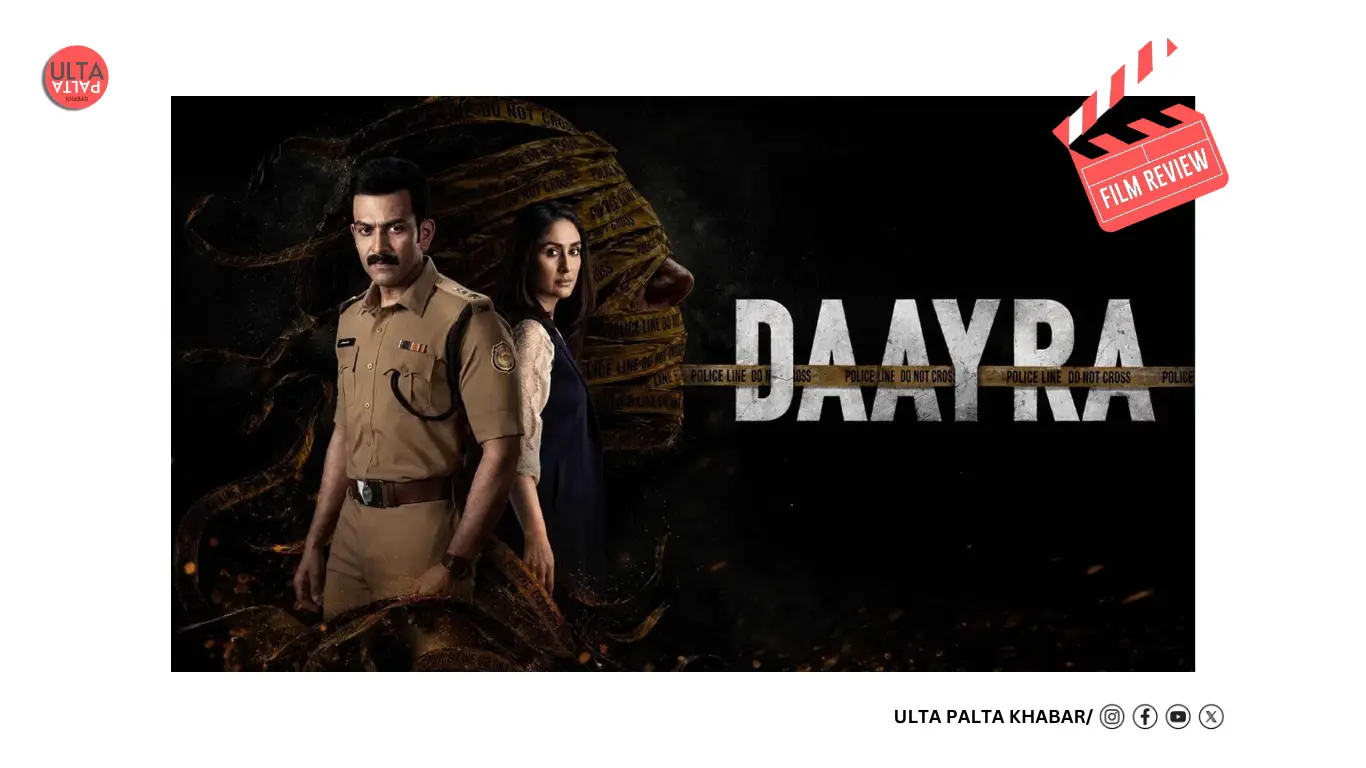

Meghna Gulzar’s Daayra puts Kareena Kapoor Khan and Prithviraj Sukumaran on opposite sides of a disturbing police investigation, questioning whether justice comes from following the law—or taking the law into your own hands.
Meghna Gulzar has never been particularly interested in making comfortable films, and Daayra continues that tradition with a crime thriller that deliberately refuses to hand the audience an easy answer.
Note: For optimal viewing on mobile devices, rotate the screen.
Starring Kareena Kapoor Khan and Prithviraj Sukumaran as two senior police officers with radically different ideas about justice, Daayra turns an encounter investigation into something far more uncomfortable: a debate about law, morality, public anger, institutional failure and the dangerous space between justice and revenge.
The film released in cinemas on September 18, 2026, and early reviews have largely highlighted its central moral conflict and performances, while differing over its pacing, character development and climax.
Note: For optimal viewing on mobile devices, rotate the screen.
Kareena vs Prithviraj: Two Cops, Two Definitions of Justice
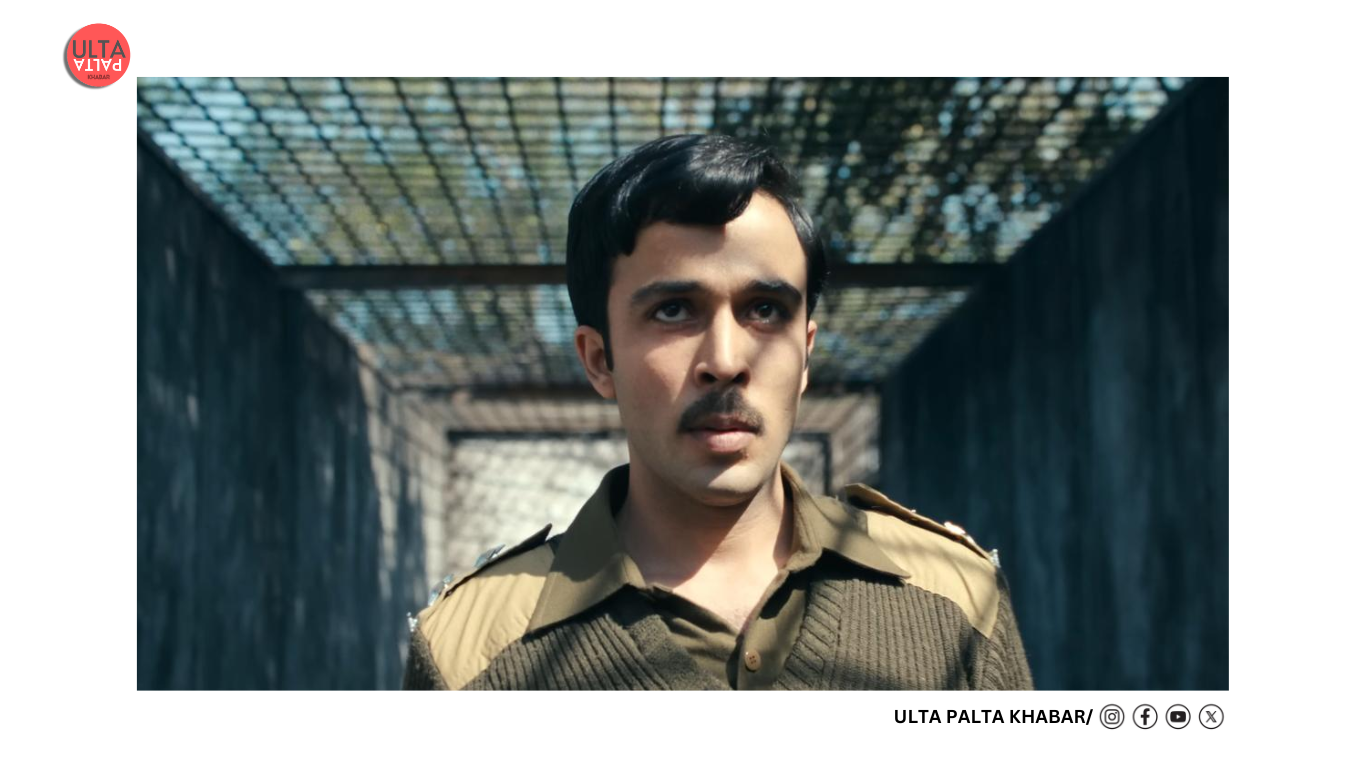
At the heart of Daayra are DCP Raman Kumar, played by Prithviraj Sukumaran, and DCP Ajooni Kohli, played by Kareena Kapoor Khan.
Raman is a police officer who believes that sometimes the system simply moves too slowly. When confronted with horrific crimes, he is willing to cross conventional boundaries in pursuit of what he believes is justice.
Ajooni, meanwhile, represents the opposite philosophy.
For her, however flawed the system may be, the law must follow its own course.
That makes Daayra less of a conventional police-versus-criminal thriller and more of a cops-versus-cops moral confrontation. Both characters believe they are working for justice. Their methods are what separate them.
The film’s central encounter case pushes that difference to the limit. A police operation that is celebrated publicly as instant justice becomes the subject of scrutiny when questions arise over whether the encounter was actually a planned shootout.
That basic setup has also been highlighted by multiple reviews, which describe the film as an exploration of competing interpretations of justice and accountability.
The Real-World Echoes Make Daayra Uncomfortable
Although Daayra is presented as fiction and is set in a fictional region, its premise inevitably evokes India’s long-running public debate around crimes against women, police encounters and the demand for swift justice.
The film’s fictional setting and characters allow Gulzar to examine these issues without turning the movie into a straightforward recreation of one particular case.
That distance actually helps.
Instead of simply asking whether an accused person deserves punishment, Daayra asks a more difficult question: Who gets to decide what justice looks like when the legal system appears to have failed?
That is where the movie becomes particularly relevant.
The public anger surrounding crimes against women can be enormous. At the same time, an encounter killing raises an entirely different set of questions about due process, evidence, accountability and the authority granted to law-enforcement officers.
Daayra deliberately sits in that uncomfortable middle ground.
A Crime Thriller Without a Traditional Hero
One of the film’s smartest decisions is that neither Raman nor Ajooni is presented as a conventional hero.
Raman’s approach is aggressive, decisive and emotionally satisfying on the surface. He represents the frustration of people who believe that justice delayed is effectively justice denied.
But Gulzar doesn’t turn him into a superhero.
His methods raise uncomfortable questions precisely because they appear effective.
Ajooni, meanwhile, follows procedure. She examines evidence, questions accounts and reconstructs what happened.
Her approach is slower and considerably less cinematic—but that is precisely the point.
The film places these two philosophies next to each other and allows the audience to sit with the contradiction.
Recent reviews have similarly praised Daayra for raising questions about justice, procedure and accountability, while some have argued that the film does not push its moral debate far enough.
Meghna Gulzar Keeps the Story Moving Through Non-Linear Storytelling
The biggest danger with a story built around an investigation is repetition.
Daayra avoids some of that trap through its non-linear structure.
The narrative moves between the investigation and earlier events involving Raman and his team. These sequences give the film a more visceral quality, particularly when police operations unfold through cramped homes, narrow lanes and chaotic environments.
The contrast between Raman’s physical, aggressive policing and Ajooni’s methodical investigation creates two different rhythms.
Raman’s world feels immediate.
Ajooni’s world feels forensic.
That distinction gives the film its identity.
The background score by Ketan Sodha further contributes to the thriller’s atmosphere, keeping the proceedings tense without turning every sequence into an action spectacle.
Prithviraj Sukumaran Is the Film’s Most Forceful Presence
Prithviraj Sukumaran has perhaps the easier of the two central performances because Raman is written with an outwardly aggressive personality.
But the actor doesn’t simply play him as an angry cop.
There is conviction behind Raman’s actions.
He doesn’t behave as though he believes he is doing something wrong. That makes the character more interesting—and more dangerous.
Prithviraj’s controlled aggression gives Raman an unsettling clarity.
He isn’t looking for approval.
He believes his actions speak for themselves.
That performance has been singled out positively by several reviews, with the Indian Express calling it a contained but effective performance and other critics similarly highlighting his presence.
Kareena Kapoor Khan Takes the More Restrained Route
Kareena Kapoor Khan’s Ajooni is almost the opposite.
There is no grandstanding.
No unnecessary shouting.
No conventional heroic monologue every ten minutes.
Instead, Kareena plays Ajooni through observation, controlled anger and quiet persistence.
Her character is forced to work within a system she knows is deeply imperfect.
That internal conflict becomes the foundation of her performance.
When Ajooni hears the victim’s family’s account, Kareena allows the emotion to remain largely beneath the surface. Her eyes do much of the work.
It is a restrained performance and, depending on how viewers respond to the film’s screenplay, potentially one of its most interesting elements.
However, this is also where critical opinion has been divided. India Today praised the performances but felt Ajooni’s personal stakes were underdeveloped, while the Indian Express argued that the film struggles to determine exactly how it wants to position Kareena’s character.
The Supporting Cast Quietly Adds Weight
Kshitee Jog leaves a particularly strong impression as the victim’s mother.
Her performance doesn’t rely on melodrama. Instead, the character’s devastation sits heavily within the film.
Kanwaljeet Singh, Jitendra Joshi and Biswapati Sarkar also contribute to the investigative world, although the screenplay gives some supporting characters less room than the central conflict.
That is one of Daayra‘s noticeable limitations.
The film is so focused on Raman and Ajooni’s ideological collision that some personal storylines feel underdeveloped.
The attempt to bring Ajooni’s family life into the larger narrative, for example, doesn’t always feel as organically integrated as the central investigation.
Where Daayra Loses Its Grip
The film’s biggest weakness is not its subject.
It is the execution of certain portions of the second half.
Several critics have pointed to pacing issues, an underwhelming confrontation or a climax that doesn’t completely deliver on the promise established earlier.
The irony is that the film spends considerable time building towards Raman and Ajooni finally facing each other.
Their philosophies have been established.
Their methods have been established.
The audience is ready for fireworks.
Instead, Gulzar chooses restraint.
That choice fits the film’s overall philosophy, but it may leave viewers expecting a bigger cinematic payoff slightly frustrated.
The Final Face-Off Doesn’t Give Easy Answers
When Raman and Ajooni finally confront each other, Daayra refuses to turn the sequence into a simplistic winner-versus-loser moment.
There is no easy declaration that one side is completely right.
There is no magical solution to institutional failure.
And there is certainly no suggestion that revenge can repair the life of a victim or family.
That unresolved quality is arguably the film’s biggest thematic strength.
At the same time, it is also the reason some viewers may walk out wanting more.
The film asks a big question but deliberately refuses to provide a comfortable conclusion.
Daayra Review: Final Verdict
Daayra is not a conventional Bollywood cop thriller.
It is a morality drama disguised as a police procedural.
Meghna Gulzar uses Kareena Kapoor Khan and Prithviraj Sukumaran to construct two competing versions of justice and then places them inside a system where neither approach offers a perfect solution.
Prithviraj brings force and conviction to Raman, while Kareena gives Ajooni an internalised, controlled intensity.
The film’s strongest moments come when these two philosophies quietly collide rather than when the screenplay tries to manufacture conventional thrills.
Its pacing and character development can occasionally test patience, and the much-awaited final confrontation may not satisfy every viewer. Critical response has therefore landed across a broad range, from praise for its performances and moral complexity to criticism of its screenplay and climax.
But Daayra succeeds at doing something increasingly rare in mainstream Hindi cinema: it asks the audience to argue with itself.
Should justice always follow procedure?
Can public anger justify extraordinary police action?
What happens when the system designed to protect people becomes too slow, too complicated or too compromised?
And perhaps the most uncomfortable question of all—if attitudes don’t change, can changing systems ever be enough?
Daayra doesn’t answer all of these questions.
It leaves them hanging in the air.
And that may be exactly the point.
Daayra Review Rating: 3/5
Verdict: A morally charged police thriller powered by Kareena Kapoor Khan and Prithviraj Sukumaran, with a compelling justice-versus-revenge conflict that sometimes loses momentum but remains relevant and thought-provoking.
Note: For optimal viewing on mobile devices, rotate the screen.
You May Like:
- ultapaltakhabar.com/hanuman-ansh-misses-oscar-deadline-inr-2-crore-film-crosses-inr-205-crore-as-makers-reveal-why-indias-official-entry-dream-was-lost/
- ultapaltakhabar.com/tamil-cinema-faces-september-shutdown-no-new-tamil-film-releases-from-september-1-as-producers-clash-with-theatre-owners-over-8-week-ott-rule/
- https://ultapaltakhabar.com/cinemark-backs-111-billion-paramount-warner-bros-merger-as-all-major-u-s-theater-chains-line-up-behind-david-ellison/
- ultapaltakhabar.com/oscars-2027-budget-youtube-move-and-ai-debate-academy-reveals-its-big-plans-for-hollywoods-future/




 By
By