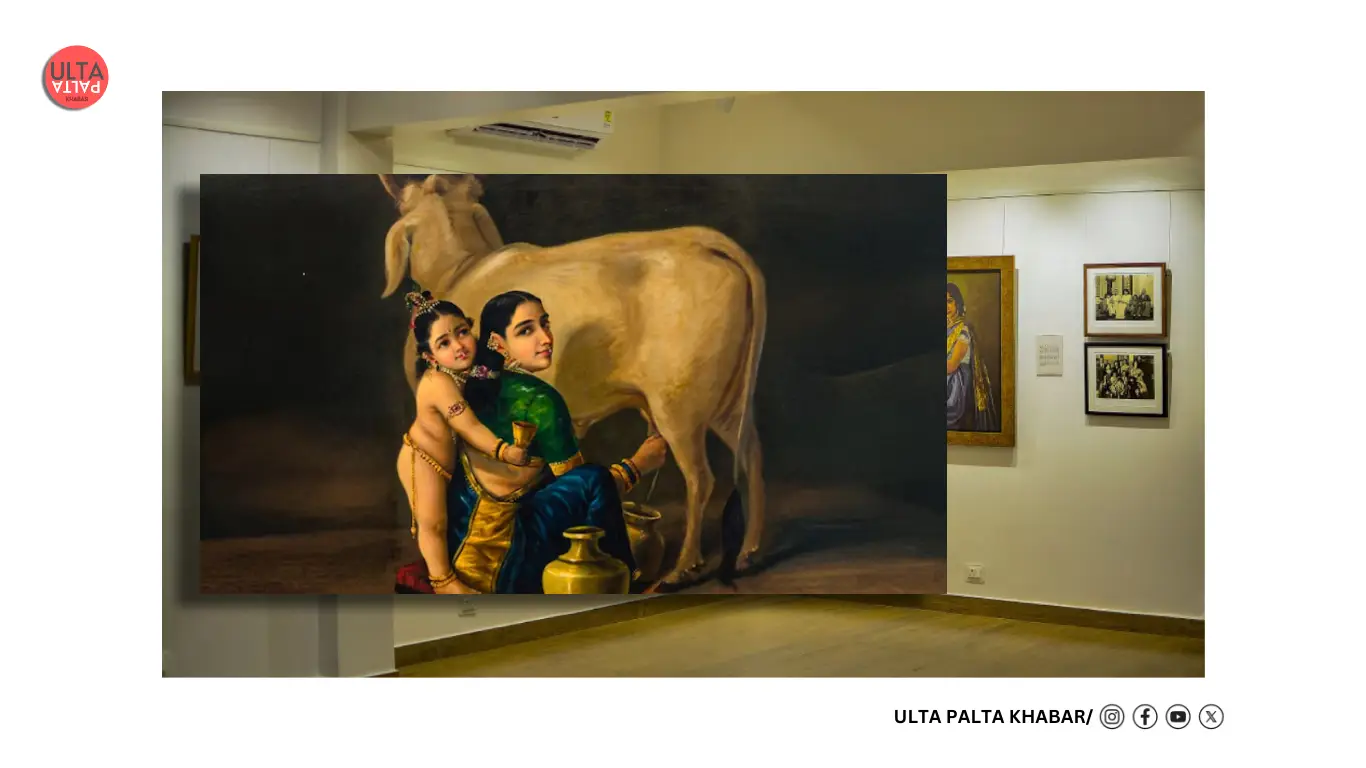

Historic sale at Saffronart sees Yashoda and Krishna redefine Indian art market as Cyrus Poonawalla pledges public access
In a moment that has sent shockwaves across the global art world, Yashoda and Krishna by legendary painter Raja Ravi Varma has shattered records, selling for an astonishing ₹167.2 crore ($17.97 million) at a high-profile auction conducted by Saffronart.
This isn’t just a sale—it’s a cultural reset.
The iconic painting, created in the 1890s, has now officially become the most expensive piece of modern Indian art ever sold, surpassing the previous record held by M. F. Husain’s Untitled (Gram Yatra). And if the numbers are anything to go by, Indian art is no longer playing catch-up—it’s leading the global conversation.
Note: For optimal viewing on mobile devices, rotate the screen.
A Tender Masterpiece That Made History
At the heart of this historic sale lies a deeply emotional image: a young Lord Krishna leaning into his mother Yashoda in a moment of quiet intimacy.
Rendered in luminous tones and soft textures, Yashoda and Krishna captures both divine mythology and human tenderness—something that became a hallmark of Raja Ravi Varma’s work.
Art historians believe this painting represents the peak of Varma’s artistic evolution, where European oil painting techniques seamlessly blended with Indian mythological storytelling.
And now, over a century later, that fusion has translated into record-breaking value.
Note: For optimal viewing on mobile devices, rotate the screen.
The Big Buyer: Cyrus Poonawalla Steps In
The winning bidder, Cyrus Poonawalla—chairman and managing director of the Serum Institute of India—has called the acquisition both a privilege and a responsibility.
“This national treasure deserves to be made available for public viewing periodically,” he stated, hinting at plans to showcase the artwork for wider audiences.
This move has been widely welcomed, especially in a country where many priceless artworks often disappear into private collections, rarely seen by the public.
From “Poster Painter” to Priceless Icon
The journey of Raja Ravi Varma is as dramatic as the auction itself.
Born in 1848 in Kilimanoor, Kerala, Varma revolutionized Indian art by bringing mythological figures to life using oil painting—a medium largely unfamiliar in India at the time.
But his legacy wasn’t always celebrated.
At one point in the 20th century, critics dismissed him as a “poster painter,” arguing that his work lacked the sophistication of traditional Indian art forms. Today, that narrative has completely flipped.
Pooyam Thirunal Gouri Parvathi Bayi, a descendant of the Travancore royal family, expressed pride in the recognition her great-grandfather is finally receiving.
“He did not paint to please critics or buyers. He painted with conviction,” she noted, adding that his work played a crucial role in popularising the sari and preserving intricate jewellery designs.
Why This Sale Matters (Big Time)
This isn’t just about one painting fetching a jaw-dropping price—it’s about what it signals for the future of Indian art.
- Indian Art Goes Global
The ₹167 crore sale firmly places Indian art on the global map, competing with European masters and contemporary Western artists. - Market Confidence Soars
The fact that the painting far exceeded its pre-auction estimate of ₹80–120 crore indicates strong confidence among collectors. - Cultural Reclaiming
With Cyrus Poonawalla ensuring the artwork remains in India, this sale is being seen as a win for cultural preservation. - New Benchmark Set
By surpassing M. F. Husain’s record, the sale resets expectations for future auctions.
The Saffronart Effect
For Saffronart, this sale is a landmark moment.
Minal Vazirani, co-founder and president, described it as more than just a financial milestone.
“Great art has a way of reaffirming its timeless value… It’s a powerful reminder of the enduring cultural and emotional resonance of Indian art,” she said.
Saffronart has long been a key player in elevating Indian art in global markets, and this sale further cements its reputation as a powerhouse in the auction world.
A Cultural Ripple Effect
The impact of this record-breaking sale is expected to ripple across multiple sectors:
- Art Galleries: Increased interest in Indian masters could drive footfall and sales
- Young Artists: A renewed focus on Indian themes and storytelling
- Collectors: A surge in demand for rare and historically significant works
- Museums: Potential collaborations to exhibit privately owned masterpieces
The Bigger Narrative: India’s Art Renaissance
In many ways, the journey of Yashoda and Krishna mirrors the evolution of Indian art itself.
From being undervalued and misunderstood to commanding global attention and record prices, the transformation is nothing short of extraordinary.
And it comes at a time when India’s cultural industries—cinema, music, fashion, and now fine art—are increasingly asserting their global influence.
What’s Next?
The big question now is: will this be a one-off event or the beginning of a larger trend?
Experts believe this sale could trigger a domino effect, with more collectors investing in Indian art and more rare works entering the auction circuit.
There’s also growing anticipation around whether other Varma masterpieces—or works by artists like M. F. Husain—could break records in the near future.
Final Take
The sale of Yashoda and Krishna isn’t just a headline—it’s a statement.
A statement that Indian art is not just culturally rich, but commercially powerful. That its stories, rooted in mythology and tradition, still resonate in a modern, globalised world.
And most importantly, that the value of art—true art—only grows with time.
Because sometimes, a painting isn’t just a painting.
It’s history, identity, and emotion—framed, preserved, and now… priceless.
Note: For optimal viewing on mobile devices, rotate the screen.
You May Like:
- ultapaltakhabar.com/gautham-menon-loses-inr-4-25-crore-legal-battle-madras-high-court-verdict-sends-shockwaves-across-tamil-film-industry/
- ultapaltakhabar.com/radikaa-sarathkumars-profit-sharing-power-move-shakes-tamil-cinema-as-thaai-kizhavi-crosses-inr-75-crore-ahead-of-ott-release/
- ultapaltakhabar.com/akshay-kumars-bhooth-bangla-vs-dhurandhar-2-storm-why-this-horror-comedy-gamble-could-change-bollywoods-box-office-game/
- ultapaltakhabar.com/oscars-2026-winners-one-battle-after-another-dominates-as-michael-b-jordan-paul-thomas-anderson-shine-at-98th-academy-awards/


 By
By