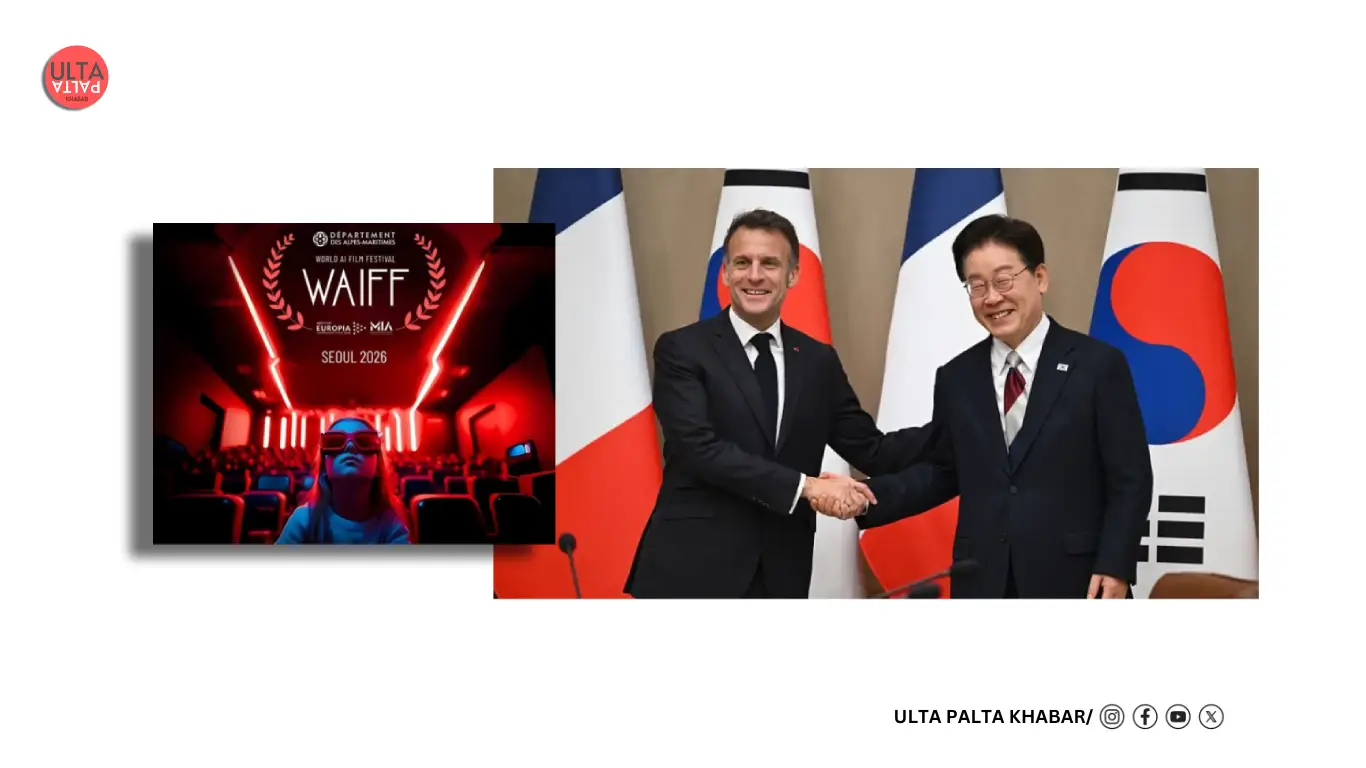

Emmanuel Macron and Lee Jae-myung join forces for a high-stakes global summit that could redefine cinema, OTT, and gaming industries
In what could become one of the most consequential moves in global entertainment policy, Emmanuel Macron has officially announced a landmark international summit dedicated to cinema, series, and video games—co-chaired with South Korean President Lee Jae-myung.
Dubbed the Cinema & Moving Image Summit, the event is already being described as a potential “reset button” for the global entertainment ecosystem. Scheduled for September 7 at the iconic Fondation Maeght, the summit will gather around 100 of the most powerful voices in global media—from studio CEOs and filmmakers to policymakers, gaming leaders, and streaming executives.
And make no mistake—this isn’t just another industry meet-and-greet. This is where the future of cinema could be negotiated.
Note: For optimal viewing on mobile devices, rotate the screen.
A Summit Born Out of Crisis—and Opportunity
The timing of this summit is no coincidence. The global entertainment industry is currently navigating one of its most turbulent transitions since the birth of cinema itself.
Gaëtan Bruel, head of France’s National Film Board (CNC), didn’t mince words when describing the stakes. Comparing the current moment to the invention of cinema by the Lumière brothers, Bruel emphasized that the industry stands at a crossroads where disruption could either dismantle traditional systems—or reinvent them entirely.
From the collapse of theatrical exclusivity to the rise of AI-generated content, the rules of storytelling are being rewritten in real time.
And that’s exactly what this summit aims to address.
Note: For optimal viewing on mobile devices, rotate the screen.
What’s On the Agenda: The Real Battle Lines
The Cinema & Moving Image Summit isn’t just symbolic—it’s strategic. The discussions are expected to focus on some of the most pressing and controversial issues shaping entertainment today:
1. The Future of Theatres vs Streaming
With box office revenues fluctuating globally, especially post-pandemic, the survival of theatrical exhibition remains uncertain. Countries like South Korea have seen their box office revenues cut by more than half between 2019 and 2024.
Streaming platforms have filled the gap—but at what cost to cinema as a communal experience?
2. The OTT-Gaming Convergence
The lines between gaming, film, and television are blurring rapidly. With narrative-driven games and cinematic universes expanding, the summit aims to explore how these industries can collaborate instead of compete.
3. Artificial Intelligence in Storytelling
AI is the elephant in the room. From scriptwriting to deepfake actors, the ethical and creative implications are massive. This summit could lay the groundwork for global AI regulations in entertainment.
4. Film Heritage & Cultural Preservation
As digital content dominates, preserving classic cinema and cultural identity has become increasingly challenging. France, known for its strong cultural policies, is expected to push hard on this front.
5. Sustainable Filmmaking
With growing environmental concerns, sustainability in production is becoming a global priority—something both France and South Korea are keen to lead.
Why France and South Korea?
At first glance, the alliance might seem unexpected—but it’s actually a power move.
France has long been a champion of auteur-driven cinema and cultural preservation, while South Korea has emerged as a global content powerhouse over the past decade.
From Oscar-winning films to streaming domination, South Korea’s rise has been nothing short of meteoric. The global success of Squid Game, created by Hwang Dong-hyuk, redefined what non-English content could achieve on platforms like Netflix.
Meanwhile, auteurs like Bong Joon-ho, whose film Parasite swept the Oscars, have elevated Korean cinema to unprecedented global recognition.
And the momentum isn’t slowing down. This year, celebrated filmmaker Park Chan-wook will preside over the jury at the Cannes Film Festival—a symbolic passing of the torch in global cinema leadership.
The Business Angle: Billions at Stake
Beyond the artistic and cultural implications, there’s serious money involved.
South Korea’s content market alone reached $43.1 billion in 2024, maintaining its position as the eighth-largest globally. That’s not just growth—that’s dominance.
France, on the other hand, continues to wield influence through policy, funding models, and international co-productions.
Together, these two nations are positioning themselves as the architects of a new global entertainment framework—one that could challenge Hollywood’s long-standing dominance.
The Hidden Power Play: Global Governance of Entertainment
Perhaps the most intriguing aspect of this summit is its ambition to establish a form of “global governance” for the entertainment industry.
That’s a big deal.
Until now, cinema, television, and gaming have largely operated without a unified global policy structure. But with AI, streaming monopolies, and cross-border content flows becoming the norm, the need for coordinated regulation is becoming urgent.
Bruel’s call for “new alliances” signals a shift toward collaboration over competition—bringing together Europe, Asia, and even the United States under a shared vision.
If successful, this summit could lead to new international agreements on everything from content distribution to intellectual property rights.
Macron’s Bigger Vision
This isn’t Emmanuel Macron’s first attempt to position France as a global leader in tech and culture convergence.
In 2025, France hosted an International AI Summit that brought together world leaders, researchers, and industry giants. The Cinema & Moving Image Summit appears to be a natural extension of that initiative—this time focusing specifically on entertainment.
By merging policy, creativity, and technology, Macron is effectively trying to future-proof the cultural industries.
What This Means for the Future
The consequences of this summit could ripple across the entire entertainment landscape:
For Filmmakers:
More opportunities for international collaborations—but also stricter regulations around AI and content ethics.
For Streaming Platforms:
Potential new rules on content distribution, revenue sharing, and cultural quotas.
For Audiences:
A more diverse, globally integrated entertainment ecosystem—but possibly fewer “free-for-all” content experiments.
For Theatres:
A renewed push to reinvent the cinematic experience—or risk becoming obsolete.
Also Read: https://ultapaltakhabar.com/april-2026-ott-explosion-full-list-of-new-movies-series/
Final Take
The Cinema & Moving Image Summit is not just another industry event—it’s a defining moment.
With Emmanuel Macron and Lee Jae-myung leading the charge, the global entertainment industry is gearing up for a transformation that could rival the invention of cinema itself.
And if the right decisions are made in that room at Fondation Maeght this September, the way we watch, create, and experience stories might never be the same again.
Note: For optimal viewing on mobile devices, rotate the screen.
You May Like:
- ultapaltakhabar.com/gautham-menon-loses-inr-4-25-crore-legal-battle-madras-high-court-verdict-sends-shockwaves-across-tamil-film-industry/
- ultapaltakhabar.com/radikaa-sarathkumars-profit-sharing-power-move-shakes-tamil-cinema-as-thaai-kizhavi-crosses-inr-75-crore-ahead-of-ott-release/
- ultapaltakhabar.com/akshay-kumars-bhooth-bangla-vs-dhurandhar-2-storm-why-this-horror-comedy-gamble-could-change-bollywoods-box-office-game/
- ultapaltakhabar.com/oscars-2026-winners-one-battle-after-another-dominates-as-michael-b-jordan-paul-thomas-anderson-shine-at-98th-academy-awards/




 By
By